




Mount Airy Chrysler Dodge Jeep Ram FIAT

Blog / Service

Those Humps, Those Humps, Those Awful Speeding Humps.

Mount Airy Speed Bump Issues

Speed hump etiquette was at the top of our list of annoying driving habits that cause road rage in Mount Airy, NC! Our staff and our customers agree. It's the worst!

More importantly, our service team wants drivers to know that incorrectly navigating speed humps can cause some very real car-care issues.

You know the drivers we're talking about.

There's the guy who doesn't seem to notice the speed hump until the very last second and slams on his brakes. There's the driver who crawls over every little hump at 2 mph while traffic backs up behind them. Then there's the driver in a lifted 4x4, complete with off-road tires and suspension, who approaches a gentle neighborhood speed hump as though they're navigating a boulder field.

And, of course, there's the person who simply refuses to participate and drives through the grass, across the shoulder or around the speed hump altogether.

Somewhere between the 2-mph crawler and the driver auditioning for the Speed Bump Olympics lies the correct answer.

The Speed Hump Offenders We All Know

The Panic Braker

This is the driver who approaches at normal speed, apparently notices the speed hump approximately 11 feet before impact and SLAMS ON THE BRAKES.

Everybody behind them brakes. The front end of the car dives. Then, after all that drama, they creep over the hump.

Besides being annoying to the people behind you, there's a mechanical reason this isn't the best approach. Hard braking shifts the vehicle's weight forward and compresses the front suspension. If you're still braking hard when the front wheels encounter the hump, you've already compressed some of the suspension travel that could have helped absorb the impact.

Repeated hard braking also creates unnecessary heat and brake wear.

The better approach? Reduce your speed gradually before reaching the hump.

The Crawler

This person encounters a broad, gently sloped speed hump designed to slow traffic and responds as though they're attempting to drive over an uncooked egg.

  • Brake.
  • Three mph.
  • Front wheels over.
  • Pause.
  • Rear wheels over.
  • Accelerate.
  • Repeat 300 feet later.

Drivers complain about this one A LOT.

One Reddit discussion complained about drivers slowing to around 5 mph for humps intended to be crossed considerably faster. Another asked why drivers practically stop for speed humps designed for traffic moving around 15 mph. And yet another driver complained that people stopping and crawling over newly installed humps were almost more annoying than the speeding traffic the humps were installed to control.

Source: Reddit

The Pavement Princess

This one is particularly entertaining for those of us at Mount Airy Chrysler Dodge Jeep Ram FIAT.

It's the lifted 4x4 with giant tires, off-road suspension and enough ground clearance to contemplate the Rubicon Trail...

...that slows to 2 mph for a suburban speed hump.

One Reddit rant was directed at the driver of a lifted Ford F-150 with huge tires and "4x4 OFF ROAD" graphics who crawled across speed humps as though the truck were navigating the Badlands.

Source: Reddit

We should probably point out that vehicles really are different.

A Jeep Wrangler, Ram 1500 Rebel or Ram 2500 Power Wagon is engineered to handle considerably rougher terrain than the average passenger car. Off-road-oriented vehicles may have additional ground clearance, taller tires, greater suspension travel, skid plates and shocks specifically designed for rough terrain.

That does NOT mean you should hit a speed bump at 40 mph.

It just makes the theatrical 2-mph crossing particularly funny.

The Off-Road Detour Guy

Why drive over a speed bump when there's perfectly good grass, a shoulder, an empty parking space or some landscaping beside it?

One discussion about speed bumps in a Walmart parking lot near Murphy, North Carolina, noted that a surprisingly large percentage of drivers simply drove through empty parking spaces to avoid the bumps.  The Walmart parking area has now become part of the traffic pattern.

Source: Reddit

Besides being inconsiderate, going around the bump can make your path unpredictable to other drivers and pedestrians.

Don't swerve around a speed bump, cross the centerline, drive through parking spaces or put two wheels on the shoulder just to save your suspension from doing its job.

The Speed-Bump Olympian

Then we have the opposite problem.

This driver doesn't slow down at all.

Apparently, this behavior is entertaining enough that there is an entire YouTube ecosystem devoted to watching what happens when drivers hit speed bumps too fast.

There's even a channel called Speed Bump Olympics dedicated to filming vehicles encountering a notorious set of speed bumps in Fresno, California. Cars, SUVs, vans and trucks bounce, scrape their undercarriages and occasionally get airborne.

While entertaining to watch, it's not exactly our recommended technique.

First Things First: Is It a Speed Bump or a Speed Hump?

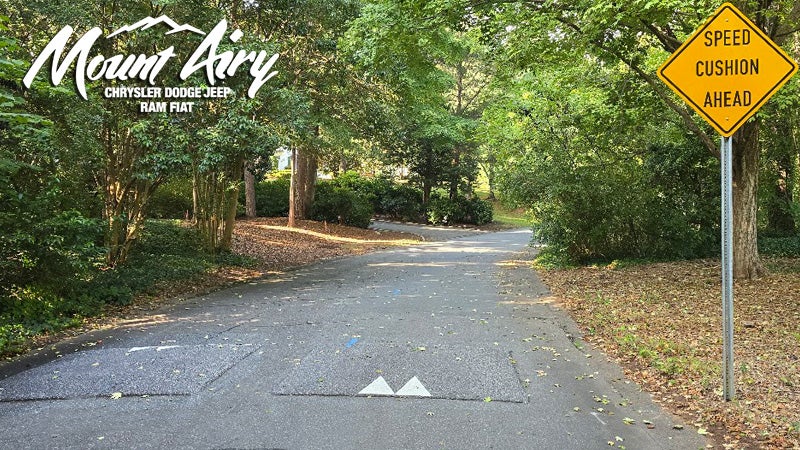
We tend to call every raised traffic-control device a "speed bump," but they're actually different.

Speed Bump

  • Short and abrupt
  • Often found in parking lots and private drives
  • Generally requires a significant reduction in speed
  • Often crossed at approximately 5 to 10 mph or less, depending on its design and your vehicle

Speed Hump

  • Broad and gradual
  • Often several feet long
  • Commonly used on neighborhood and residential streets
  • Frequently designed for vehicles traveling approximately 15 to 25 mph, depending on the particular hump and posted speed

Speed Table

  • Longer than a traditional speed hump
  • Has a flat section across the top
  • Often used at pedestrian crossings and on streets where traffic needs to slow without nearly stopping
  • Many can be crossed comfortably at approximately 15 to 25 mph or more, depending on their design and posted speed

The important part is this:

Not every lump in the road requires the same response.

A short, abrupt parking-lot speed bump and a long, gently sloped speed table are completely different obstacles.

Pay attention to the design, road markings and posted or advisory speed rather than automatically slamming on your brakes every time you see something raised in the pavement.

Can Hitting Speed Bumps Incorrectly Damage Your Vehicle?

Yes.

Your suspension is designed to absorb bumps, dips and imperfections in the road. That doesn't mean every vehicle can absorb every obstacle at every speed.

Shocks, Struts and Suspension Components

This is the obvious one.

Your suspension absorbs vertical movement between the wheels and the vehicle. Hit an abrupt bump too quickly and you can force suspension components through an extremely rapid compression and rebound.

Repeated abuse can contribute to premature wear of shocks, struts, bushings and other suspension components.

Wheel Alignment and Steering

Hit a significant bump hard enough and you can knock your wheel alignment out of specification.

If you notice your vehicle pulling to one side, an off-center steering wheel or unusual tire wear after a particularly nasty encounter with a speed bump, pothole or curb, your alignment may be worth checking.

Tires and Wheels

A hard vertical impact can also damage a tire or wheel, particularly if your tires are underinflated or your vehicle has low-profile tires with less sidewall available to absorb the impact.

The Undercarriage

This is especially important for sports cars, lowered vehicles and anything with limited ground clearance.

Potential victims include:

  • Front bumpers and splitters
  • Exhaust components
  • Underbody panels
  • Aerodynamic panels
  • Other low-mounted components

If your vehicle sits low, slowing down for an abrupt speed bump isn't being overly cautious. It's protecting the bottom of your car.

Your Brakes

The speed hump itself isn't damaging your brakes.

Your driving habits might be.

The driver who accelerates to 30 mph between every speed hump and then brakes aggressively to 5 mph is converting that extra speed into heat and brake wear over and over again.

If you're traveling through an area with multiple speed humps, maintaining a reasonable, consistent speed is easier on your brakes, easier on your vehicle and considerably less annoying to everyone behind you.

But My Jeep or Ram Is MADE for Bumps!

Well...sort of.

Vehicle design absolutely matters.

A low sports car with stiff suspension, low-profile tires and limited ground clearance needs more caution than an off-road-oriented truck or SUV with taller tires, additional suspension travel, greater ground clearance and underbody protection.

Many Jeep and Ram models are specifically engineered for rough terrain. Depending on the model and package, that can include:

  • Increased ground clearance
  • Off-road suspension
  • Performance shocks
  • All-terrain tires
  • Skid plates
  • Greater suspension travel

But there's an important distinction.

Off-road capable does not mean speed-bump invincible.

Even a capable truck or SUV can bottom its suspension, unload its tires or come crashing back onto the pavement if it hits an abrupt obstacle at excessive speed.

Your suspension may be tough.

Your coffee in the cupholder is not.

So, What IS the Right Way to Go Over a Speed Hump?

It's really pretty simple.

  • Look ahead. Seeing the hump early eliminates the entire Panic Braker problem.
  • Figure out what you're dealing with. Is it a short, abrupt speed bump, a broad speed hump or a long speed table? Pay attention to signs and road markings.
  • Reduce your speed early and gradually. Do your braking before you reach the hump rather than slamming on your brakes at the last second.
  • Ease off heavy braking before your front wheels climb the hump. Hard braking transfers weight forward and compresses the front suspension. Slow down first, then let the suspension do its job.
  • Cross the hump straight and smoothly. Don't suddenly swerve, straddle it, invade the other lane or take a scenic tour through somebody's landscaping.
  • Let the rear wheels clear the hump before accelerating normally.
  • Adjust for your vehicle. A low sports car, minivan, Jeep Wrangler and Ram 2500 aren't going to cross every obstacle comfortably at precisely the same speed. Ground clearance, wheelbase, tire profile, suspension design and vehicle load all matter.
  • Remember there's probably somebody behind you. Slow down appropriately, but don't turn every gentle neighborhood speed hump into a complete traffic stop when conditions and the design of the hump don't require it.

Don't Be THAT Driver

Speed humps exist because somebody, somewhere, was driving too fast.

Ironically, they can create an entirely new collection of irritating driving habits.

There's no prize for crossing one at 2 mph, and there's definitely no prize for launching your vehicle over one at 40.

The goal isn't to see how slowly or how quickly you can get over the hump.

Slow down early. Choose a speed appropriate for the type of hump and your vehicle. Cross it smoothly. Then keep moving.

Your brakes will appreciate it.


Posted in:

Related Posts

Tinted Windows make a difference in the temperature of your car.

How Hot Does Your Car Get in 90 Degree Weather?

In just 20 minutes your car can get to 120 degrees in 90 degree heat! Keep Your Car Cool this Summer! You may have noticed that the heat has been especially taxing lately when you get into your car. People are experiencing record-high temperatures across the world. In fact, the recent July 4th Holiday, and the days that followed it, marked the hottest days ever on record. If one thing comes from this heat, it’s likely an increase in the gratitude you have for your vehicle’s working air condition system. But did you know that automobile A/C spans all the way back to 1933? Despite the game-changing invention’s roots, it took 20 more years to make its way into some semblance of standard production. And what was the brand and vehicle to do it? Chrysler did it with the 1953 Chrysler Imperial (the “Airtemp” system). Moral of the story: If you’re looking for a brand committed to helping you stay cool, check out Mount Airy Chrysler Dodge Jeep Ram Fiat — part of the brand family that pioneered keeping you comfortable! Enough with the history lessons, though; what’s really important is knowing what this historic heat wave means for your car’s air conditioning and your ability to remain comfortable in record temperature highs! Understanding Your Vehicle’s Air Conditioning Most people rarely put any thought into their air conditioning other than, “Ah, I’m glad it’s on!” But what exactly makes it work? Air conditioning units typically have three main parts: the compressor, the condenser, and the evaporator. The compressor is responsible for drawing out refrigerant — the agent responsible for cooling and moving it into the condenser. Once the refrigerant enters the condenser, it removes the moisture, pushing out cool air. Finally, it reaches the evaporator in the vehicle’s cabin, which evaporates the refrigerant and returns it to its liquid form, allowing the whole process to begin again. Feel free to read more about the science behind your vehicle’s air conditioning at this resource provided by Mount Airy Chrysler Dodge Jeep Ram and Fiat! Knowing how your car gets cool is a necessary first step to protecting that system. Ways To Take Care of Your Vehicle’s Air Conditioner While the system breakdown seems complex on the surface, knowing just a few simple tips to ensure its longevity can be the difference between a summer of fun and one where you dread leaving your home. Utilize Your Vehicle’s Defrost Mode While turning on defrost in a record-breaking heatwave may seem ludicrous, it can go a long way for the health of your car. Defrost mode at the highest and coldest setting ensures your compressor is running and takes care of any potential growth of mold and mildew. It’s a practice worth doing consistently, as frequently as once a week — even during winter! Pay Attention to Your Air Filter Dirty air filters contain dirt and particle accumulation that can block airflow, which forces your air conditioner to work harder. Have your filter checked, cleaned, and replaced regularly. Your vehicle will thank you! Maintain a Clean Car While on the topic of filters, one way to ensure your filters aren’t inundated with dirt, dust, and other particles is by keeping your car clean to begin with. The more items in your car that contribute to the mess, the higher the likelihood of your air filters becoming clogged. Create a simple routine of tidying your interior each day. Set Your Car to the Coldest Setting Air conditioning works best in its coolest setting. Turning towards a milder temperature will force your car to adjust the temperature it puts out instead of defaulting to the regular coldest setting. If you find yourself shivering, try adjusting the power of the fan instead of the temperature. This simplifies the job your unit has and results in a comfortable trip. Don’t Cool Your Car Before Driving In the winter, warming your car before driving is an excellent way to take care of your vehicle and ensure the long life of its heater. That couldn’t be further from the truth with cooling your vehicle. A vehicle’s air conditioning works best when you’re driving, so a sitting car can put more pressure on your air conditioning. If you want to get cool as quickly as possible, you can try rolling down your back windows for the first few seconds to push out hot air. Otherwise, hop in and start driving. Your car will be cool before you know it! Don’t Recirculate Your A/C if You Have Passengers in the Backseat Recirculating your A/C is a good idea if you’re the only person in the car, but the setting pulls the cooler air from the back of your vehicle, meaning a world of discomfort for those potential passengers in the back seat. Instead, make sure your fans point to the optimal points in your vehicle to keep every passenger is comfortable. Have Your Car Serviced By Professionals While these tips will extend the life of your air conditioner, it’s normal for it to run into problems (like all systems and machines). Going to service your car with a dealership or mechanic that has the necessary expertise is one of the only ways to remedy a malfunctioning air conditioner. Other Ways To Keep Your Car Cool An air conditioner can only do so much, so how else can you keep your vehicle cool? Finding ways to prevent your vehicle from getting extremely hot in the first place is key to staying cool and removing pressure from your air conditioner. After all, the inside of your vehicle is usually hotter than the air around it! Limit Exposure to the Sun Parking in the shade or utilizing a window shade screen is a sure way to reduce the overall temperature of your parked car. This makes it easier for your air conditioner to bring it to a comfortable temperature quicker. Crack Your Windows It’s old advice, but it’s sage. Cracking your windows lets your car stay at a reasonable temperature instead of baking in the sun. That, plus a running A/C, forces the hot air out and holds the cold air in. Window Tinting? One question many people have is, “Does window tinting keep my car cool?” The short answer is yes. Window tinting reduces the amount of thermal rays, keeping your car's overall temperature down. This is one of the main reasons people tint their vehicles, office windows, etc. That said, don’t run and schedule a window tinting appointment just yet! Some state and local laws don’t allow window tinting. The darkest tint allowed in North Carolina is 32%, though some people can tint up to 70% with a medical exception. If you’re scheduling an appointment for window tinting, or doing it from home, make sure you comply with all the current rules and regulations. Having your car be a tad warmer is better than receiving a costly ticket! Getting Familiar With Mount Airy CDJRF’s Service Department With the recent record-breaking heat wave, it’s a good idea to service your vehicle before we enter the hotter days that are surely ahead. And if you’re in North Carolina, Virginia, or the surrounding Mount Airy area, there’s no better place to go for a much-needed service than Mount Airy Chrysler Dodge Jeep Ram and Fiat. “Mount Airy Chrysler Dodge Jeep Ram FIAT has been doing business in Surry County since the 1960s. Our commitment to our customers does not stop at the new car department.  We intend to stick with you and give you the very best that we have to offer throughout the lifetime of your car, truck, or SUV.  We aim to please you by offering comprehensive care via our car service and repair center.” – Mount Airy CDJRF The professionals at Mount Airy CDJRF want to work with you and your schedule to ensure your service appointment goes as smoothly as possible. With a schedule anywhere link, you can set up your next service appointment in no time, right from your phone. Then there’s the fact that we offer of a “ Social Distance” service, where you can have your car taken care of by simply dropping your vehicle off! See what one customer has to say regarding how easy our dealership make a service appointment: Concerning air conditioning, Mount Airy CDJRF has the knowhow to make sure your car will be cool all summer long, and the dealership’s service team has a track record of repairing A/C systems for the long haul: Don’t sweat the heat! Call and schedule a service appointment with Mount Airy Chrysler Dodge Jeep Ram Fiat today to keep your summer cool and fun!

Top Service Center Near Me

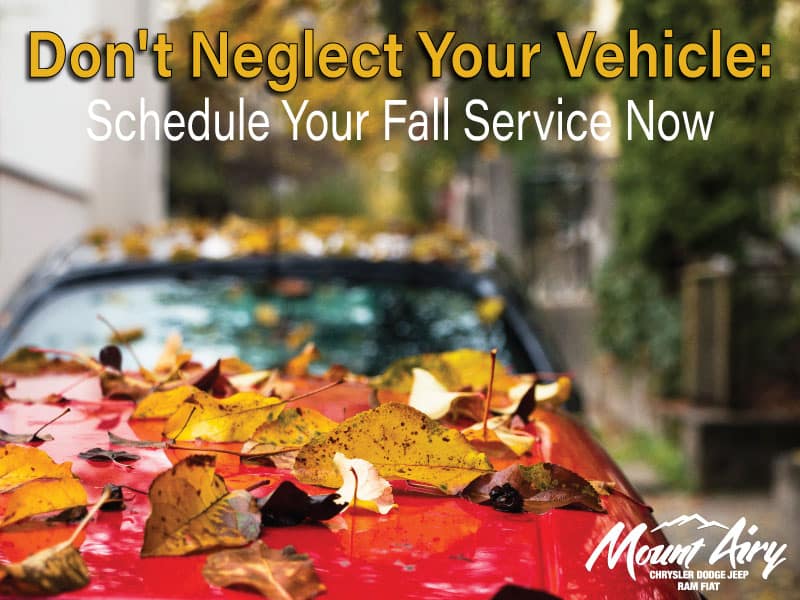
Don't Neglect Your Vehicle: Schedule Your Fall Service Now

As the leaves start to change color and the weather gets cooler, it's essential to start thinking about fall maintenance for your vehicle. Just like you need to prepare your home for the colder months, your car also needs attention to ensure it runs smoothly all season long. Below, Mount Airy CDJRF explains the importance of getting an oil change and handling a few other things before the frigid weather arrives. Let’s get you ready for the frost! Getting an Oil Change One of the most important things you can do for your car this fall is to get an oil change. Along with helping your car run smoothly, this will also prevent any rust or corrosion that can happen during the winter months. Regular oil changes are crucial no matter what time of year it is. Dirty oil can cause all sorts of problems for your engine, and as the temperature starts to drop in the fall, you'll want to ensure your engine is well-lubricated. How often you should get your oil changed depends on several factors, such as the type of engine oil you use, the make and model of your vehicle, and how you drive it. Most mechanics recommend getting an oil change every 3,000 miles or every three months, whichever comes first. If you're not sure when you last had your oil changed, take your car in for a check-up before the weather gets too cold! Checking Your Battery Cold weather can be tough on car batteries, so it's a good idea to have yours tested before winter arrives. A weak battery will struggle to start your car on cold mornings, so save yourself the headache and get it replaced now if necessary. There are a few things that can drain a car battery, such as leaving the headlights on, using the car's power outlets, or constantly having a lot of electronics plugged in. If you're not going to be using your car for an extended period of time, consider disconnecting the battery altogether. Doing so will help keep the battery from dying while it's sitting in storage. Inspecting Your Tires Take a look at your tires to ensure they have enough tread and are properly inflated. This is important for both safety and fuel efficiency. If you live in an area that gets a lot of snow, you might want to invest in a set of winter tires. While it’s always best to get a mechanic’s opinion, you can measure your tires’ tread depth and check for uneven wear from home. To measure the tread depth, place a penny upside down so that Lincoln's head faces down into the tire's grooves. If you can't see Lincoln's head, the tread is deep enough. If you can see his head, the tread needs to be replaced. To check for uneven wear, place a piece of paper on the tops of each tire and drive in a straight line. The paper should move evenly across each tire. If it doesn't, then one side of the tire is wearing down more than the other, which could be a sign that you need to get your wheels aligned. Topping Off Your Fluids As temperatures drop, you'll want to ensure all the fluid levels in your car are where they should be. The primary fluids to check in your vehicle include: Engine oil Transmission fluid Brake fluid Power steering fluid Windshield wiper fluid Antifreeze/coolant If any of these fluids are low, top them off or get them replaced as needed. These fluids play a critical role in keeping your car running smoothly, so keep an eye on them! Cleaning Out Your Car Now is a good time to give your car a good cleaning — inside and out. Remove any clutter that has accumulated over the summer months, and give the interior a thorough vacuuming and wipe-down. Don't forget about the trunk! And while you're at it, wash (or better yet, wax) the exterior of your car to protect the paint and keep it looking shiny and new. Conclusion The colder months are arriving, and it's essential to give your vehicle the attention it needs. Start by getting an oil change, then inspect your battery, tires, and fluids and replace whatever is necessary. Following these simple tips will prepare your car to run smoothly for the next several months — and help you avoid stressful surprises. Take time this season to service your vehicle with Mount Airy CDJRF, and enjoy worry-free driving all year round!

Service Center Mount Airy NC

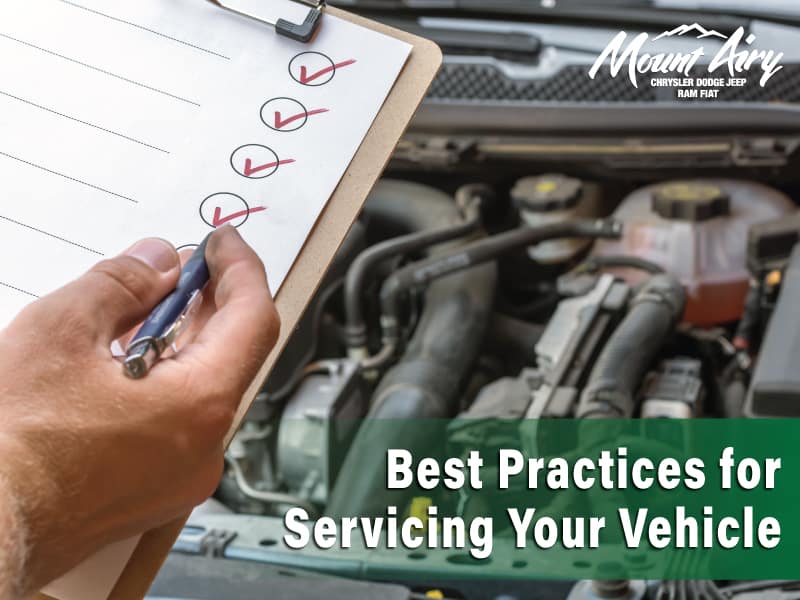
Best Practices for Servicing Your Vehicle

Keeping up with your vehicle’s servicing needs is critical for ensuring a safe driving experience—both for the people in your car and others on the road. Performing routine maintenance is also an excellent way to save time and money in the long run. But how do you know when it’s time to service your vehicle? What if you’ve lost track of your maintenance schedule or don’t know how to identify an isolated problem with the brakes, tires, or other components? The service experts at Mount Airy CDJR are committed to helping our customers prolong the performance and life of their vehicles. And we’ve provided some practical information and advice for keeping your vehicle up to speed on its maintenance: The Brakes No one needs to tell you how important your vehicle’s brakes are for safe driving. But sometimes it can be tricky to distinguish whether you have a problem with your brakes or it’s something else. One of the most common indicators that you need your brakes serviced is if you hear a loud, unpleasant noise, such as screeching, grinding, or growling when you apply the brakes. If you notice your brakes becoming less responsive or your vehicle pulling to one side when you press the brakes, those could also be signs that you need to bring your car in. Furthermore, steering wheel vibration when traveling downhill or braking at higher speeds can indicate a brake problem. By bringing your vehicle to a qualified mechanic, you will know whether the problem is with the brake pads, rotors, or something else entirely. The Tires As with brakes, it’s difficult to drive safely when your tires are in bad shape. Never let your tires get to the point where they are bald on the edges, and if you do, get them replaced immediately. Also, check your car manual, get a tire gauge, and regularly check the air pressure to ensure your tires are not over-or under-inflated. Along with increasing safety, the correct air pressure can boost your fuel economy. Generally speaking, you’ll want to take your vehicle in for a tire rotation every 6,000 to 8,000 miles to keep the wear even (check your car manual for exact mileage). The Oil If you want to prolong the life of your engine, nothing is more important than oil changes. When performed regularly, changing the oil is relatively simple and inexpensive. But if you neglect this practice, it can lead to more extensive, costly repairs. Most older cars require an oil change every three months or 3,000 miles, while most newer models can wait six months or 6,000 miles. Along with keeping track of your mileage, here are a few signs that your vehicle needs an oil change: • The “Check Engine” or “Oil Change” light comes on. • The oil is dark or dirty. • You can smell engine oil from inside the cabin. • Your exhaust is releasing smoke. • Your general engine noise becomes louder, or you hear knocking or rumbling sounds. Wiper Blades If you don’t have a clear view of the road ahead, you’re putting yourself and others in danger. Along with passing a basic vision test, you need to keep your windshield wipers in good shape! Depending on where you live and the quality of wipers you choose, you should plan on changing out the blades every six to 12 months. That said, anytime you notice corroded metal, worn-out or damaged rubber, screeching sounds, or poor cleaning performance from your wipers, it’s a good sign that you should replace them. The Battery Several factors can impact the performance of your car’s battery, including age, extreme temperatures, and long periods of inactivity. Batteries are designed to wear out, and most are warrantied and rated according to time rather than mileage. In general, you can expect a car battery to run well for four or five years, which means about 50,000 to 60,000 miles for the average driver. Regularly check the terminals on your battery for corrosion and dirt. If you’re not sure when it was last replaced, a mechanic can test its charge capability. Conclusion To ensure safe driving and prolong the life of your vehicle, it’s essential to have it serviced regularly. But you also want to look out for the signs mentioned above for problems that fall outside of routine maintenance. Moreover, pay attention to your air filter, fuel filter, fluids (e.g., transmission fluid, power steering fluid, engine coolant, etc.), hoses, belts, and any other components that may need to be serviced. Mount Airy CDJR services a wide range of vehicles every day, so schedule an appointment anytime for routine maintenance or any isolated issues you may have!