Mount Airy Chrysler Dodge Jeep Ram FIAT

Blog / Accessories

Smart Add-Ons: How to Save Money on a New Car and Upgrade Later

Smart Add-Ons: How to Save Money on a New Car and Upgrade Later
Buying a new car is exciting—but it can also be overwhelming when you start adding up the cost of extra features. Many shoppers love the idea of heated seats, leather upholstery, or advanced technology packages, but the price of these add-ons straight from the factory can cause some serious sticker shock. The good news? You don’t have to decide on everything the moment you drive off the lot. At Mount Airy Chrysler Dodge Jeep Ram Fiat (CDJRF), we help customers save money up front by purchasing a vehicle with the essentials and then adding features later through our trusted service and body shop team. car add-ons Mount Airy This approach gives you flexibility: you get the car you want now, stay within budget, and still have the option to customize it with upgrades when you’re ready. Why Add Features After You Buy?
  1. Budget Control Factory-installed packages often bundle features you don’t necessarily want, forcing you to pay for extras just to get one upgrade. Dealer-installed add-ons let you pick only what you want and pay for it when it fits your budget.
  2. Flexibility Your needs may change after purchase. Maybe you don’t need leather seats today, but next year you decide they’d make daily driving more comfortable. Waiting gives you time to prioritize what really matters.
  3. Trusted Installation At Mount Airy CDJRF, our body shop and certified technicians are equipped to install hundreds of accessories designed specifically for Chrysler, Dodge, Jeep, Ram, and Fiat models. You’ll get professional results that look and feel factory fresh.
  4. Save on Financing Costs Every feature rolled into the original purchase price gets financed—meaning you pay interest on it for the life of your loan. Adding upgrades later can save you money because you can pay for them directly instead of financing.
Popular Add-Ons Customers Love When it comes to dealer-installed upgrades, some features consistently top the list because of their comfort, convenience, and value. Here are the most popular add-ons we install for our customers:
  • Heated Seats – Add warmth and comfort without the factory bundle.
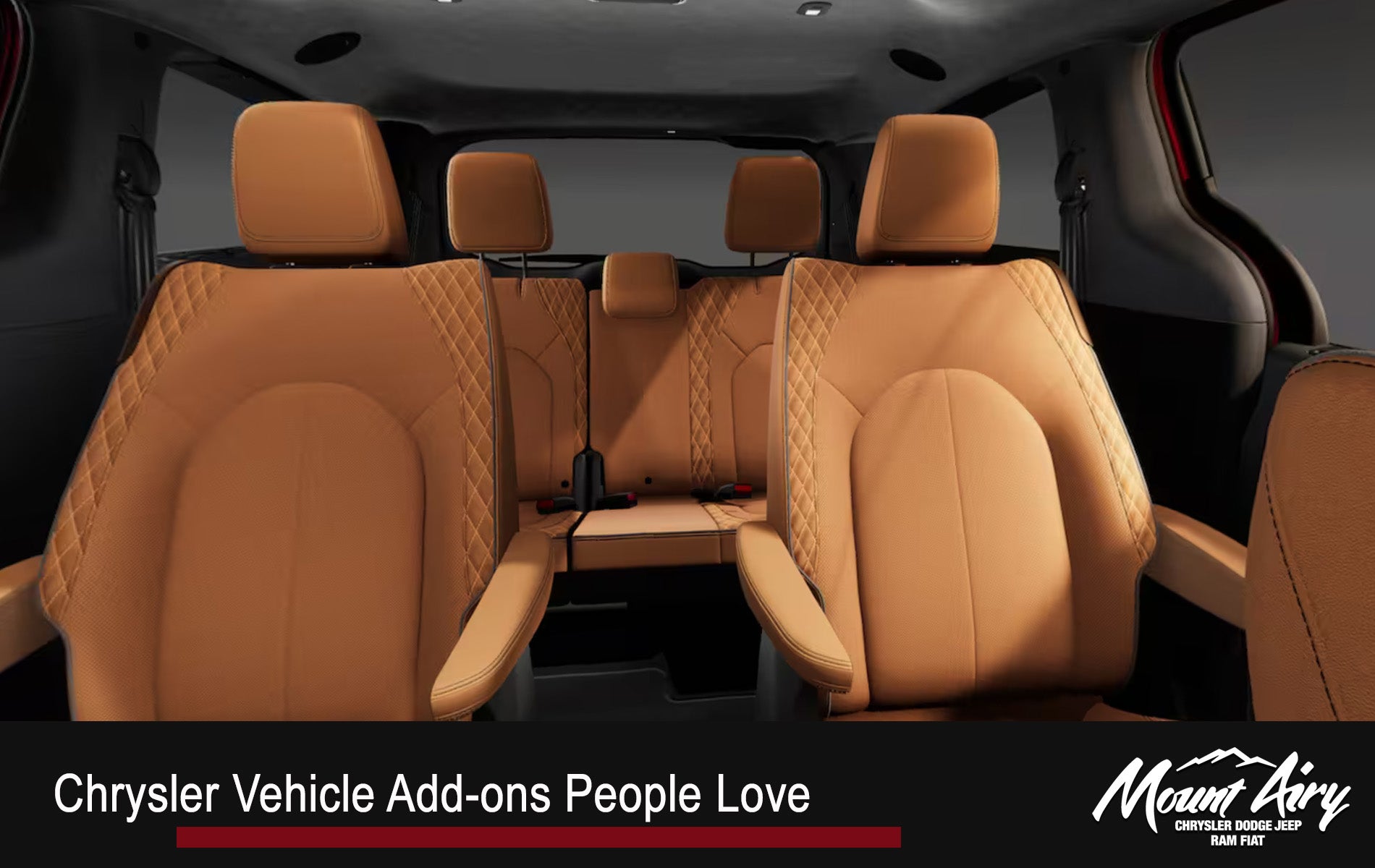
  • Leather Seat Upholstery – A premium look and feel, installed by our upholstery specialists.
  • Remote Start Systems – Perfect for warming up your vehicle on cold mornings or cooling it down in summer.
  • Upgraded Audio Systems – From enhanced speakers to full infotainment upgrades.
  • All-Weather Floor Mats – Protect your investment with durable mats for mud, snow, and spills.
  • Running Boards & Side Steps – A must-have for trucks and SUVs for easier entry.
  • Bed Liners & Covers (Ram Trucks) – Protect your truck bed and keep cargo secure.
  • Tow Hitches & Packages – Add towing capability for trailers, campers, and boats.
  • Custom Wheels & Tires – Upgrade style and performance at the same time.
  • Roof Racks & Cargo Carriers – Extra storage for road trips and outdoor adventures.
  • Window Tinting – Reduce glare, keep interiors cooler, and add privacy.
  • Safety Tech Additions – Backup cameras, sensors, and blind-spot monitors for older models.
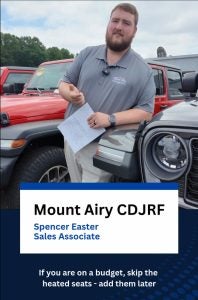
Example: Heated Seats & Leather Interiors As Spencer Easter explains in our featured video, heated seats and leather are two upgrades where you can really save. Buying these features from the factory usually requires a package that includes other items—pushing the price tag much higher. By choosing a base or mid-level trim and then having our team install heated seats and leather later, you get the best of both worlds: a lower purchase price and the premium comfort you really wanted. How the Installation Process Works
  1. Consultation – Our sales consultants and service advisors, lead by Jessica Manuel, work with you to plan which features you’d like now and which can be added later.
  2. Certified Parts & Accessories – We only use genuine Mopar parts and approved accessories for Chrysler, Dodge, Jeep, Ram, and Fiat vehicles.
  3. Professional Installation – Our body shop team ensures your upgrades look seamless, like they came straight from the factory.
  4. Warranty Protection – Many dealer-installed accessories are covered under warranty, giving you peace of mind.
The Value of Customization Every driver has unique needs. Some prioritize off-road gear for their Jeep, while others want premium audio in their Dodge Charger or towing upgrades for a Ram 1500. Instead of paying for features you don’t need, customizing your car after purchase means your vehicle fits your lifestyle—not the other way around. Save Now, Upgrade Later If you’re shopping for a new vehicle but need to stick to a budget, don’t feel pressured to buy every upgrade immediately. At Mount Airy Chrysler Dodge Jeep Ram Fiat, we can help you design a long-term plan for your vehicle that saves money now and still gives you the flexibility to enjoy premium features in the future. Our body shop can add hundreds of accessories that enhance comfort, style, safety, and performance—all with the quality and expertise you expect from our dealership. Ready to Learn More? Watch our video with Sales Consultant Spencer Easter to hear firsthand how smart add-ons can help you save money when buying a new car. Then visit us at Mount Airy CDJRF to start planning your next upgrade.  
Posted in:

Related Posts

2026 RAM Rebel vs RAM RHO

2026 RAM 1500 RHO vs RAM 1500 Rebel: Which Off-Road RAM Fits Your North Carolina Lifestyle?

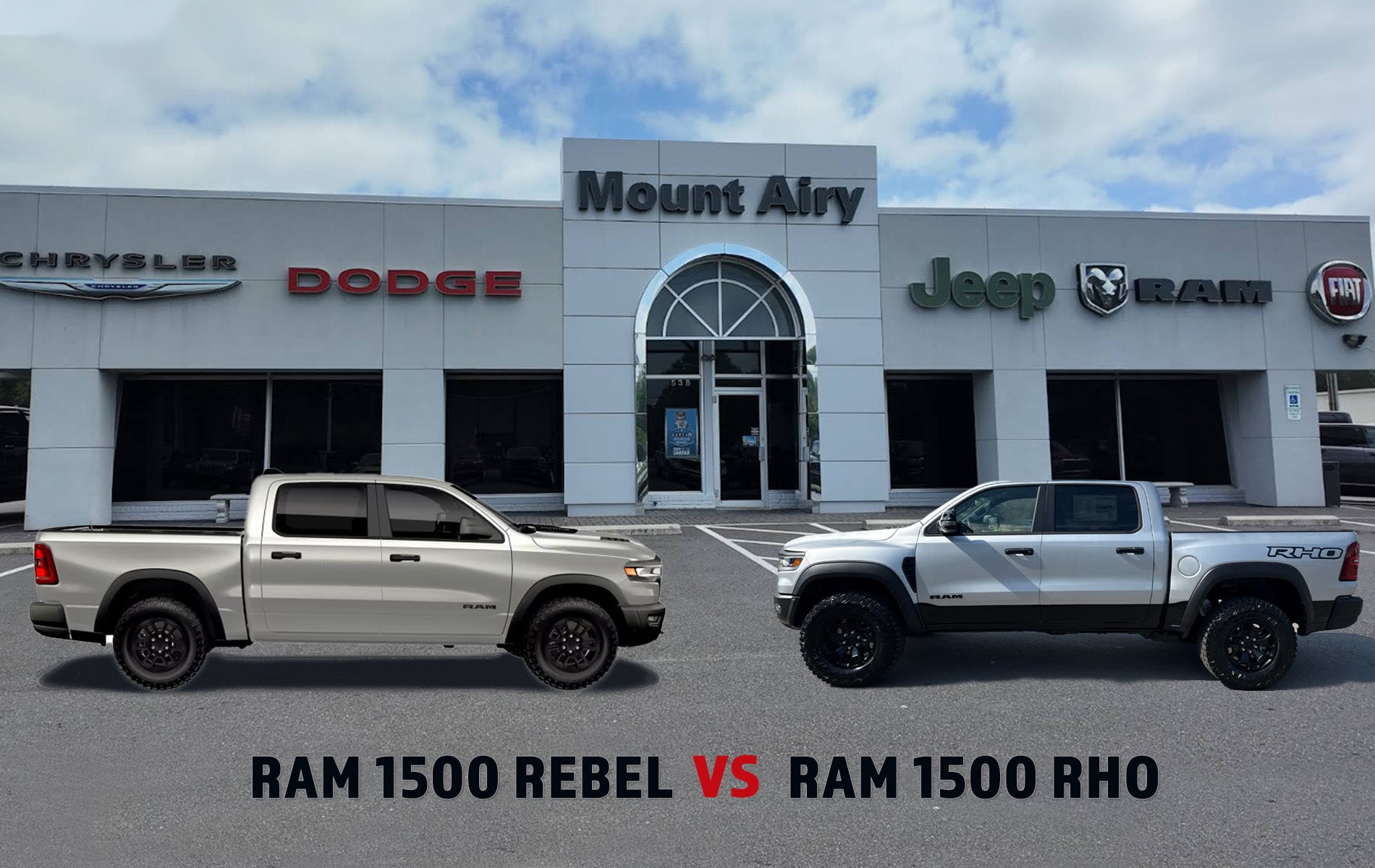
The 2026 RAM 1500 Rebel and the 2026 RAM 1500 RHO are both built for outdoor adventure, but they target very different types of truck buyers. The Rebel is designed to balance daily driving with camping trips, towing, mountain travel, and weekend off-roading throughout North Carolina. The RHO takes things much further, combining premium luxury with aggressive off-road capability, advanced suspension technology, and high-speed dirt-road performance. Both trucks can handle muddy backroads, mountain trails, fishing trips, and rough weather with confidence. The real question is whether the RHO’s added performance and technology justify the higher price for the way you actually plan to use your truck. For some buyers, the Rebel will be the smarter all-around adventure vehicle. For others, the RHO delivers a level of capability and refinement that few factory trucks can match. Dirt Road Performance vs Everyday Adventure In North Carolina, most off-road truck owners are not racing across desert dunes. They are driving gravel mountain roads near Boone and Blowing Rock, pulling campers through muddy campground entrances, navigating forest service roads, and heading to fishing spots deep in the Appalachians. That is where the differences between the Rebel and the RHO start to matter. The Rebel is designed to comfortably balance daily driving with weekend outdoor adventure, while the RHO is engineered for more aggressive off-road capability, advanced suspension performance, and premium refinement on rough terrain. Suspension Differences: Bilstein Technology Matters The suspension setup is one of the largest differences between these trucks. The Ram Rebel uses a proven off-road suspension with Bilstein shocks and a factory lift that delivers excellent ride quality on pavement while still handling rough trails comfortably. The RHO takes suspension technology much further. It uses the advanced Bilstein Black Hawk e2 adaptive shock system, which constantly monitors: Steering input Throttle position Terrain conditions Vehicle movement The system automatically adjusts damping in real time to help keep the truck stable, controlled, and comfortable across changing terrain conditions. This gives the RHO an incredibly controlled ride over rough dirt roads, washboard surfaces, and uneven terrain. One of the most surprising things reviewers consistently mention is how refined the RHO still feels on the highway despite its aggressive off-road hardware. Truck Width, Garage Fit, Height Clearance, and Everyday Usability The RHO’s wider stance, 35-inch tires, and aggressive fender flares create incredible road presence, but they can also make: Garage fit tighter Parking decks more stressful Narrow mountain roads trickier Daily maneuvering slightly more challenging The Rebel is still a full-size truck, but its slightly narrower setup and 33-inch tires make it feel more manageable in suburban neighborhoods, older garages, and mountain-town environments. For buyers in North Carolina, garage fit is worth considering before purchase, especially in older homes where garage dimensions may be smaller than modern standards. Measurement Ram Rebel Ram RHO Average 1-Car Garage Average 2-Car Garage Width (Without Mirrors) 82.1 inches 88 inches 144 inches wide 240 inches wide Remaining Width Clearance 61.9 inches 56 inches — — Clearance Per Side 30.95 inches 28 inches — — Approximate Height 77.6 inches 80.9 inches 84-inch garage opening 84-inch garage opening Remaining Height Clearance 6.4 inches 3.1 inches — — Many truck owners online mention that rooftop tents and 35-inch tire setups can quickly create clearance problems with garage doors and parking decks. For buyers planning future camping or overlanding upgrades, the Rebel’s slightly lower stance may offer more flexibility for everyday garage use, while the RHO delivers a much more aggressive appearance and commanding off-road presence. Ground Clearance Differences Ground clearance matters more than many buyers realize, especially on uneven forest roads, muddy campsites, and rocky mountain access trails. Approximate ground clearance: Ram Rebel: 9.7 inches Ram RHO: 11.8 inches The additional clearance on the RHO helps protect the underbody during more aggressive off-road driving and allows the truck to clear obstacles more easily. Still, the Rebel offers more than enough clearance for most camping, fishing, and outdoor travel situations throughout North Carolina and Virginia. Camping Features and Rooftop Tent Compatibility Both trucks can absolutely become excellent camping and overlanding rigs. The Rebel may actually be the easier and more affordable platform for many camping enthusiasts because owners often feel more comfortable modifying it with: Rooftop Tents |  Bed Racks |  Cargo Systems |  Recovery Gear |  Camping Accessories  |  Split Tailgate The RHO can certainly handle rooftop tents and overlanding setups, but many buyers hesitate to heavily modify such an expensive high-performance truck. Because the Rebel sits slightly lower and uses smaller tires, rooftop tent access can also feel a little easier for everyday camping use. Both trucks offer large bed space, power outlets, towing capability, cargo flexibility, and strong aftermarket support for outdoor adventure builds. The Hurricane Twin-Turbo Engine Explained One of the biggest differences between the Rebel and the RHO is the version of Ram’s new Hurricane twin-turbo inline-six engine used in each truck. Feature RAM Rebel RAM RHO Engine 3.0L Hurricane Twin-Turbo Inline-6 High-Output 3.0L Hurricane Twin-Turbo Inline-6 Horsepower 420 HP 540 HP Torque 469 lb-ft 521 lb-ft Driving Characteristics Balanced power for towing, daily driving, and outdoor adventure Extreme acceleration and aggressive off-road performance Power Delivery Smooth low-end turbo torque with strong everyday responsiveness Massive turbocharged torque with high-performance tuning and rapid acceleration Fuel Efficiency Compared to Older V8s Improved efficiency with strong towing capability Better efficiency than previous high-output V8 performance trucks The power delivery in both trucks feels very different from older naturally aspirated V8 trucks. Turbocharged torque arrives quickly and smoothly, making both the Rebel and the RHO feel responsive even at lower RPMs. The Rebel focuses more on balanced everyday usability, while the RHO delivers significantly more aggressive acceleration and high-performance driving characteristics. Interior Comparison: RAM Rebel vs RAM RHO The interior differences between the Rebel and the RHO become much more noticeable once you get inside the truck. While both models offer modern technology, large touchscreens, and premium comfort features, the RHO pushes further into luxury-truck territory with more upscale materials and high-end technology. Feature RAM Rebel RAM RHO Interior Characteristics Rugged, practical, outdoor-focused Premium, high-tech, luxury-oriented 12-Inch Touchscreen Standard or available depending on trim Standard 14.5-Inch Touchscreen Not typically available Available / Often equipped Passenger Interactive Display Not available on most Rebel configurations Available option Massaging Front Seats Not available Available option Leather / Suede Seating Available depending on package Standard or commonly equipped Harman Kardon Premium Audio Available option Available / Frequently equipped Carbon Fiber Interior Accents Not typical Available Advanced Driver Assistance Features Available depending on package More comprehensive package availability Everyday Driving Comfort Excellent balance of comfort and utility Luxury-truck comfort with aggressive off-road capability Rebel Interior with Red Accents RHO Interior Luxury Comfort Seats The Rebel still offers impressive comfort and technology for everyday driving, camping trips, towing, and mountain travel. The RHO simply adds another level of premium materials, advanced technology, and luxury-focused features for buyers wanting a more upscale off-road truck experience. Which Truck Is More Appropriate for North Carolina Mountain Driving? North Carolina mountain driving presents very different challenges than wide-open off-road terrain. Drivers regularly deal with tight winding roads, steep elevation changes, gravel backroads, heavy rain, occasional snow, and narrow campground or trail entrances throughout the Appalachians. These conditions make everyday maneuverability, suspension comfort, traction, and overall truck size especially important when deciding between the Ram Rebel and the more aggressive Ram RHO. For many buyers, the Rebel may feel easier to maneuver every day because it is slightly less aggressive in overall width, tire size, and ride height. The RHO shines on rough dirt roads and uneven terrain where its advanced suspension system can fully show its capabilities. Buyers whose lifestyle includes long mountain drives, towing campers, rough access roads, outdoor recreation, and daily commuting may find the Rebel offers the better overall balance of comfort, practicality, and capability. Buyers looking for maximum off-road performance, premium luxury, aggressive styling, and trophy-truck-inspired characteristics will likely find the RHO far more appealing. Bed Utility and Tailgate Features Both the Ram Rebel and the Ram RHO are designed to handle outdoor gear and active lifestyles, whether you are loading fishing equipment, coolers, camping supplies, mountain bikes, kayaks, or towing accessories. Both trucks come standard with: Bed lighting Trailer towing technology Trailer assistance features Multiple cargo tie-down points Easy-access tailgate functionality Available features on both trucks, depending on configuration and option packages, may include: Power outlets in the bed Adjustable cargo management systems Spray-in bedliners Power tailgate functionality Advanced trailer camera systems Ram’s tailgate design remains one of the most practical in the truck industry, especially for loading heavier outdoor equipment and camping gear. Buyers planning to tow boats, campers, or outdoor trailers will find both trucks highly capable, although the Rebel may appeal more to buyers prioritizing towing balance while the RHO leans further toward premium off-road performance. Recovery Points and Skid Plates Recovery points and skid plates are two of the most important features on a serious off-road truck, especially for drivers exploring mountain roads and remote outdoor areas in North Carolina. Recovery points, often called tow hooks or recovery hooks, provide secure attachment locations for tow straps, winches, or recovery gear if a truck becomes stuck in mud, snow, loose gravel, or uneven terrain. They are especially valuable on steep mountain trails, muddy campground entrances, and rough forest service roads where traction conditions can change quickly. Skid plates are heavy-duty protective panels mounted underneath the truck to help shield critical components like the engine, transmission, fuel tank, and transfer case from rocks, ruts, tree stumps, and rough terrain. In mountain environments with uneven access roads and hidden obstacles, skid plates can help prevent extremely expensive damage underneath the vehicle. Both the Ram Rebel and the Ram RHO come equipped with serious off-road protection. Depending on configuration, buyers may find: Skid plates Tow hooks and recovery points Locking rear differentials Off-road drive modes Upgraded transfer cases The RHO takes things further with more aggressive underbody protection and additional suspension travel designed for higher-speed off-road capability and rough terrain performance. The Rebel remains extremely capable for the type of driving most North Carolina truck owners are realistically doing, including muddy trails, hunting property access roads, mountain travel, snow, and campground or fishing access roads throughout the Appalachian region. Towing Comparison One surprise for many buyers is that the Rebel can actually out-tow the RHO when properly configured. Approximate towing capacity: Rebel: Up to 11,140 lbs RHO: Around 8,360 lbs That matters for buyers towing: Campers Fishing boats Enclosed trailers Side-by-sides Outdoor equipment The RHO prioritizes suspension travel and high-speed off-road performance, while the Rebel retains stronger towing flexibility for many real-world truck owners. Choose the RAM Rebel if you want: Choose the RAM RHO if you want: Everyday practicality Strong towing capability Outdoor adventure versatility Easier mountain driving Better garage friendliness Lower ownership cost Balanced daily comfort A more manageable everyday driving experience Maximum off-road performance Premium luxury features Advanced adaptive suspension Factory 35-inch tires Trophy-truck-inspired characteristics High-speed dirt-road capability A more aggressive off-road appearance One of the most advanced Ram trucks ever built For many North Carolina buyers, the Rebel may ultimately be the smarter all-around adventure truck thanks to its balance of comfort, practicality, towing capability, and everyday usability. However, buyers looking for the ultimate Ram off-road experience will find that the RHO delivers an impressive combination of power, luxury, suspension technology, and aggressive off-road capability that few factory trucks can match.

 Best Car Accessories

A Christmas List for Your Vehicle

It’s getting to that time of year again, the one when you struggle to find gifts for friends and family—even yourself! This year, make it easy and get those you love something that can make life more convenient and comfortable. Car accessories, add-ons, tools, and enhancements are abundant and are the perfect gift for those hard-to-buy-for individuals. Make travel easier and more fun by creating your own Christmas list for your vehicle. What should make your vehicle Christmas list? All things that enhance your driving experience in terms of convenience, comfort, and safety are worth considering. Honestly, there are so many options out there when it comes to personalizing your vehicle that it can become a bit overwhelming, which is why Mount Airy Chrysler Dodge Jeep Ram has culled a list of this year’s 10 best vehicle add-ons. Check out what we found: 1. The TWC-01. Car vacuum—$25 on Amazon. Keeping a car clean can be difficult, especially when children are involved. The presence of a compact, powerful car vacuum can help you to clean messes up in the moment. Especially handy for those longer car rides, the TWC-01 comes with a 16-foot cord that plugs into the car itself, allowing for cleaning in even the hardest-to-reach areas. 2. Amazon Echo Auto—$50 on Amazon. Anyone who uses Alexa regularly will benefit from this gift. The Echo Auto is a small gadget that connects Alexa to your car and lets you use the virtual assistant safely. Once the Echo is incorporated, you can use it for entertainment and navigation by speaking into any of the eight built-in microphones. 3. Reverse Travel Umbrella—$26 on Amazon. What makes this umbrella special is that it is both wind resistant and it folds inside of itself, which keeps it from leaking over the interior of your car (everyone hates that terrible mess of trying to quickly enter the car while simultaneously folding up the umbrella only so it can then pour all the rainwater it collected over you and the inside of your car; kind of defeats the purpose of the umbrella). It also comes with a lifetime warranty and is offered in a variety of colors. In other words, you'll be dry and stylin’! 4. Bluetooth 5.0 FM Transmitter—$40 at Amazon. Feeling bad because you don’t have the latest and greatest infotainment inside your car? Worry no more with the 5.0 Transmitter that charges phones, transmits the radio, and manages phone calls. This tool’s multifunctionality makes it effective on multiple levels—it can even play audio files, act as a virtual assistant, and light up! 5. One-Touch Cup Holder Car Mount—$29 at Amazon. Using this car mount is a great way to put that extra, unused cup holder to use. The base of the phone mount locks into place, ensuring it won’t move or fall out while driving, so your phone can securely charge and navigate as you drive. It even comes with a magnetic cord organizer to keep wires from being strewn about the car—and it's compatible with any modern smartphone brand. 6. RAD 480i Laser Radar Detector—$150 Amazon. Hmmm, what’s the perfect gift for that speed demon in the family? A radar detector! And not just any radar either, the RAD 480i accurately detects both laser and radar plenty in advance for the driver to make any necessary adjustments to speed. The accuracy is due to the app’s real-time updates combined with its ability to discern false alerts. Hopefully, this handy gadget will teach responsibility rather than encourage poor driving behaviors… 7. RESQME Keychain Car Escape Tool—$10 Amazon. It should be standard that everyone has an emergency escape tool inside the car. We hate to even think about getting stuck inside or having someone stuck inside the car, but it happens. The RESQME tool can quickly break glass and cut seat belts. It’s also incredibly lightweight and easy to store—and it comes in tons of colors. $10 isn’t much when it comes to keeping yourself and your loved ones safe. 8. The Drive Bin—$12 Amazon. Rather than using the car floorboards as a communal trash bin, allow your children the privilege of tossing garbage into an actual garbage bin. It's so hard to keep a car clean, but it’s amazing what a perfectly sized little trashcan can do. The Drive Bin is waterproof (leaky drinks!) and comes with disposable plastic bags. Even better, it can adjust in shape,  so it fits just about anywhere you like inside your car—even attached to your headrest. 9. Riparo Motorsports Driving Gloves—$50 Amazon. Ergonomically crafted with quality soft leather, the Riparo Driving Gloves are an excellent gift for anyone who drives—short or long distances. The perforated areas of the glove help to grip the wheel, and as they age, they mold to your hands and develop a patina. These come in multiple sizes and clip at the wrist for a secure fit. 10. Tile Pro Bluetooth Tracker—$25 Amazon. As frustrating as it is to lose your car keys (why is it always when we're in a rush that this happens?), you would think everyone would have this product. The Tile Pro can track your keys from as far as 400 miles away, and it’s waterproof. For $25, this should be in every stocking this year. Our Favorite Travel Apps Even with the best add-ons and apps and devices, traveling can be tricky, especially when the whole family is involved. Over the holidays any form of travel feels extra difficult—scurrying for flights, vying for parking spots, and learning new ways to get stuck in traffic. Luckily, these days there are plenty of apps to download that can keep you relaxed and on time to all of your destinations this holiday season. Here are the travel apps we are most excited about this year: Flightradar24 Get up-to-date information on any flight you want 24 hours a day. With this app, you will get notice of delays, cancellations, changes in locations, etc. so that you're always in the know of your flight status. Once you register with this app, you can view all fights from the past, as well as current ones, and you'll always get accurate information. Skyscanner Since the costs of flights fluctuate so much, it’s best to have an app like this one that can scour the internet to find you the cheapest flight possible. All you need to know are your travel dates, and Skyscanner will do the rest. You can also filter flight times, number of stops, and other characteristics. Another nice aspect to this app is that it stores all your information, so you always know where you are in terms of purchasing tickets. PackPoint This unique app literally helps you pack your suitcases. Sounds crazy, but it works! Simply download the app, answer a few specific questions about your upcoming trip, and the app will create a packing list of things you need. These things will be based on weather forecasts in the area you are heading, and it will even provide locations of fun activities, gas stations, and anything else you specify as needed. Even better, the generated list is always customizable so you can make minor adjustments where necessary. Waze Getting lost is awful, but getting caught in severe traffic might be worse (at least you are moving while lost). Waze not only points you in the right direction, it considers traffic patterns in real-time and it makes adjustments while you're driving—these tweaks in direction are updated as drivers make notes on the app itself: if there is a car accident and you make note of it in Waze, it will update the entire system. Waze gets you where you're going by people helping people. Safe travels this holiday season, and best of luck—not that you’ll need it with these apps!

Mount Airy Speed Bump Issues

Those Humps, Those Humps, Those Awful Speeding Humps.

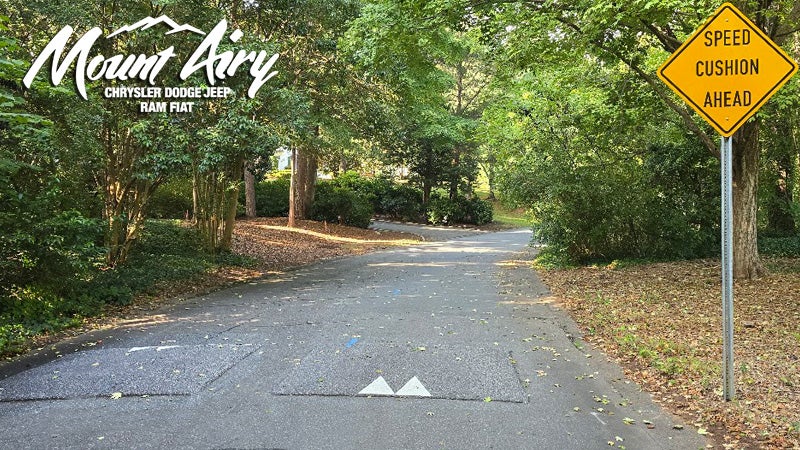
Speed hump etiquette was at the top of our list of annoying driving habits that cause road rage in Mount Airy, NC! Our staff and our customers agree. It's the worst! More importantly, our service team wants drivers to know that incorrectly navigating speed humps can cause some very real car-care issues. You know the drivers we're talking about. There's the guy who doesn't seem to notice the speed hump until the very last second and slams on his brakes. There's the driver who crawls over every little hump at 2 mph while traffic backs up behind them. Then there's the driver in a lifted 4x4, complete with off-road tires and suspension, who approaches a gentle neighborhood speed hump as though they're navigating a boulder field. And, of course, there's the person who simply refuses to participate and drives through the grass, across the shoulder or around the speed hump altogether. Somewhere between the 2-mph crawler and the driver auditioning for the Speed Bump Olympics lies the correct answer. The Speed Hump Offenders We All Know The Panic Braker This is the driver who approaches at normal speed, apparently notices the speed hump approximately 11 feet before impact and SLAMS ON THE BRAKES. Everybody behind them brakes. The front end of the car dives. Then, after all that drama, they creep over the hump. Besides being annoying to the people behind you, there's a mechanical reason this isn't the best approach. Hard braking shifts the vehicle's weight forward and compresses the front suspension. If you're still braking hard when the front wheels encounter the hump, you've already compressed some of the suspension travel that could have helped absorb the impact. Repeated hard braking also creates unnecessary heat and brake wear. The better approach? Reduce your speed gradually before reaching the hump. The Crawler This person encounters a broad, gently sloped speed hump designed to slow traffic and responds as though they're attempting to drive over an uncooked egg. Brake. Three mph. Front wheels over. Pause. Rear wheels over. Accelerate. Repeat 300 feet later. Drivers complain about this one A LOT. One Reddit discussion complained about drivers slowing to around 5 mph for humps intended to be crossed considerably faster. Another asked why drivers practically stop for speed humps designed for traffic moving around 15 mph. And yet another driver complained that people stopping and crawling over newly installed humps were almost more annoying than the speeding traffic the humps were installed to control. Source: Reddit The Pavement Princess This one is particularly entertaining for those of us at Mount Airy Chrysler Dodge Jeep Ram FIAT. It's the lifted 4x4 with giant tires, off-road suspension and enough ground clearance to contemplate the Rubicon Trail......that slows to 2 mph for a suburban speed hump. One Reddit rant was directed at the driver of a lifted Ford F-150 with huge tires and "4x4 OFF ROAD" graphics who crawled across speed humps as though the truck were navigating the Badlands. Source: Reddit We should probably point out that vehicles really are different. A Jeep Wrangler, Ram 1500 Rebel or Ram 2500 Power Wagon is engineered to handle considerably rougher terrain than the average passenger car. Off-road-oriented vehicles may have additional ground clearance, taller tires, greater suspension travel, skid plates and shocks specifically designed for rough terrain. That does NOT mean you should hit a speed bump at 40 mph. It just makes the theatrical 2-mph crossing particularly funny. The Off-Road Detour Guy Why drive over a speed bump when there's perfectly good grass, a shoulder, an empty parking space or some landscaping beside it? One discussion about speed bumps in a Walmart parking lot near Murphy, North Carolina, noted that a surprisingly large percentage of drivers simply drove through empty parking spaces to avoid the bumps.  The Walmart parking area has now become part of the traffic pattern. Source: Reddit Besides being inconsiderate, going around the bump can make your path unpredictable to other drivers and pedestrians. Don't swerve around a speed bump, cross the centerline, drive through parking spaces or put two wheels on the shoulder just to save your suspension from doing its job. The Speed-Bump Olympian Then we have the opposite problem. This driver doesn't slow down at all. Apparently, this behavior is entertaining enough that there is an entire YouTube ecosystem devoted to watching what happens when drivers hit speed bumps too fast. There's even a channel called Speed Bump Olympics dedicated to filming vehicles encountering a notorious set of speed bumps in Fresno, California. Cars, SUVs, vans and trucks bounce, scrape their undercarriages and occasionally get airborne. While entertaining to watch, it's not exactly our recommended technique. First Things First: Is It a Speed Bump or a Speed Hump? We tend to call every raised traffic-control device a "speed bump," but they're actually different. Speed Bump Short and abrupt Often found in parking lots and private drives Generally requires a significant reduction in speed Often crossed at approximately 5 to 10 mph or less, depending on its design and your vehicle Speed Hump Broad and gradual Often several feet long Commonly used on neighborhood and residential streets Frequently designed for vehicles traveling approximately 15 to 25 mph, depending on the particular hump and posted speed Speed Table Longer than a traditional speed hump Has a flat section across the top Often used at pedestrian crossings and on streets where traffic needs to slow without nearly stopping Many can be crossed comfortably at approximately 15 to 25 mph or more, depending on their design and posted speed The important part is this: Not every lump in the road requires the same response. A short, abrupt parking-lot speed bump and a long, gently sloped speed table are completely different obstacles. Pay attention to the design, road markings and posted or advisory speed rather than automatically slamming on your brakes every time you see something raised in the pavement. Can Hitting Speed Bumps Incorrectly Damage Your Vehicle? Yes. Your suspension is designed to absorb bumps, dips and imperfections in the road. That doesn't mean every vehicle can absorb every obstacle at every speed. Shocks, Struts and Suspension Components This is the obvious one. Your suspension absorbs vertical movement between the wheels and the vehicle. Hit an abrupt bump too quickly and you can force suspension components through an extremely rapid compression and rebound. Repeated abuse can contribute to premature wear of shocks, struts, bushings and other suspension components. Wheel Alignment and Steering Hit a significant bump hard enough and you can knock your wheel alignment out of specification. If you notice your vehicle pulling to one side, an off-center steering wheel or unusual tire wear after a particularly nasty encounter with a speed bump, pothole or curb, your alignment may be worth checking. Tires and Wheels A hard vertical impact can also damage a tire or wheel, particularly if your tires are underinflated or your vehicle has low-profile tires with less sidewall available to absorb the impact. The Undercarriage This is especially important for sports cars, lowered vehicles and anything with limited ground clearance. Potential victims include: Front bumpers and splitters Exhaust components Underbody panels Aerodynamic panels Other low-mounted components If your vehicle sits low, slowing down for an abrupt speed bump isn't being overly cautious. It's protecting the bottom of your car. Your Brakes The speed hump itself isn't damaging your brakes. Your driving habits might be. The driver who accelerates to 30 mph between every speed hump and then brakes aggressively to 5 mph is converting that extra speed into heat and brake wear over and over again. If you're traveling through an area with multiple speed humps, maintaining a reasonable, consistent speed is easier on your brakes, easier on your vehicle and considerably less annoying to everyone behind you. But My Jeep or Ram Is MADE for Bumps! Well...sort of. Vehicle design absolutely matters. A low sports car with stiff suspension, low-profile tires and limited ground clearance needs more caution than an off-road-oriented truck or SUV with taller tires, additional suspension travel, greater ground clearance and underbody protection. Many Jeep and Ram models are specifically engineered for rough terrain. Depending on the model and package, that can include: Increased ground clearance Off-road suspension Performance shocks All-terrain tires Skid plates Greater suspension travel But there's an important distinction. Off-road capable does not mean speed-bump invincible. Even a capable truck or SUV can bottom its suspension, unload its tires or come crashing back onto the pavement if it hits an abrupt obstacle at excessive speed. Your suspension may be tough. Your coffee in the cupholder is not. So, What IS the Right Way to Go Over a Speed Hump? It's really pretty simple. Look ahead. Seeing the hump early eliminates the entire Panic Braker problem. Figure out what you're dealing with. Is it a short, abrupt speed bump, a broad speed hump or a long speed table? Pay attention to signs and road markings. Reduce your speed early and gradually. Do your braking before you reach the hump rather than slamming on your brakes at the last second. Ease off heavy braking before your front wheels climb the hump. Hard braking transfers weight forward and compresses the front suspension. Slow down first, then let the suspension do its job. Cross the hump straight and smoothly. Don't suddenly swerve, straddle it, invade the other lane or take a scenic tour through somebody's landscaping. Let the rear wheels clear the hump before accelerating normally. Adjust for your vehicle. A low sports car, minivan, Jeep Wrangler and Ram 2500 aren't going to cross every obstacle comfortably at precisely the same speed. Ground clearance, wheelbase, tire profile, suspension design and vehicle load all matter. Remember there's probably somebody behind you. Slow down appropriately, but don't turn every gentle neighborhood speed hump into a complete traffic stop when conditions and the design of the hump don't require it. Don't Be THAT Driver Speed humps exist because somebody, somewhere, was driving too fast. Ironically, they can create an entirely new collection of irritating driving habits. There's no prize for crossing one at 2 mph, and there's definitely no prize for launching your vehicle over one at 40. The goal isn't to see how slowly or how quickly you can get over the hump. Slow down early. Choose a speed appropriate for the type of hump and your vehicle. Cross it smoothly. Then keep moving. Your brakes will appreciate it.