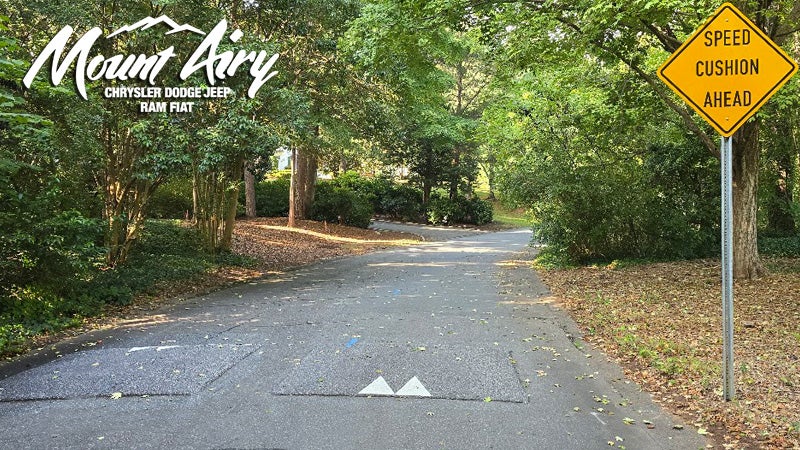
Speed hump etiquette was at the top of our list of annoying driving habits that cause road rage in Mount Airy, NC! Our staff and our customers agree. It's the worst! More importantly, our service team wants drivers to know that incorrectly navigating speed humps can cause some very real car-care issues. You know the drivers we're talking about. There's the guy who doesn't seem to notice the speed hump until the very last second and slams on his brakes. There's the driver who crawls over every little hump at 2 mph while traffic backs up behind them. Then there's the driver in a lifted 4x4, complete with off-road tires and suspension, who approaches a gentle neighborhood speed hump as though they're navigating a boulder field. And, of course, there's the person who simply refuses to participate and drives through the grass, across the shoulder or around the speed hump altogether. Somewhere between the 2-mph crawler and the driver auditioning for the Speed Bump Olympics lies the correct answer. The Speed Hump Offenders We All Know The Panic Braker This is the driver who approaches at normal speed, apparently notices the speed hump approximately 11 feet before impact and SLAMS ON THE BRAKES. Everybody behind them brakes. The front end of the car dives. Then, after all that drama, they creep over the hump. Besides being annoying to the people behind you, there's a mechanical reason this isn't the best approach. Hard braking shifts the vehicle's weight forward and compresses the front suspension. If you're still braking hard when the front wheels encounter the hump, you've already compressed some of the suspension travel that could have helped absorb the impact. Repeated hard braking also creates unnecessary heat and brake wear. The better approach? Reduce your speed gradually before reaching the hump. The Crawler This person encounters a broad, gently sloped speed hump designed to slow traffic and responds as though they're attempting to drive over an uncooked egg. Brake. Three mph. Front wheels over. Pause. Rear wheels over. Accelerate. Repeat 300 feet later. Drivers complain about this one A LOT. One Reddit discussion complained about drivers slowing to around 5 mph for humps intended to be crossed considerably faster. Another asked why drivers practically stop for speed humps designed for traffic moving around 15 mph. And yet another driver complained that people stopping and crawling over newly installed humps were almost more annoying than the speeding traffic the humps were installed to control. Source: Reddit The Pavement Princess This one is particularly entertaining for those of us at Mount Airy Chrysler Dodge Jeep Ram FIAT. It's the lifted 4x4 with giant tires, off-road suspension and enough ground clearance to contemplate the Rubicon Trail......that slows to 2 mph for a suburban speed hump. One Reddit rant was directed at the driver of a lifted Ford F-150 with huge tires and "4x4 OFF ROAD" graphics who crawled across speed humps as though the truck were navigating the Badlands. Source: Reddit We should probably point out that vehicles really are different. A Jeep Wrangler, Ram 1500 Rebel or Ram 2500 Power Wagon is engineered to handle considerably rougher terrain than the average passenger car. Off-road-oriented vehicles may have additional ground clearance, taller tires, greater suspension travel, skid plates and shocks specifically designed for rough terrain. That does NOT mean you should hit a speed bump at 40 mph. It just makes the theatrical 2-mph crossing particularly funny. The Off-Road Detour Guy Why drive over a speed bump when there's perfectly good grass, a shoulder, an empty parking space or some landscaping beside it? One discussion about speed bumps in a Walmart parking lot near Murphy, North Carolina, noted that a surprisingly large percentage of drivers simply drove through empty parking spaces to avoid the bumps. The Walmart parking area has now become part of the traffic pattern. Source: Reddit Besides being inconsiderate, going around the bump can make your path unpredictable to other drivers and pedestrians. Don't swerve around a speed bump, cross the centerline, drive through parking spaces or put two wheels on the shoulder just to save your suspension from doing its job. The Speed-Bump Olympian Then we have the opposite problem. This driver doesn't slow down at all. Apparently, this behavior is entertaining enough that there is an entire YouTube ecosystem devoted to watching what happens when drivers hit speed bumps too fast. There's even a channel called Speed Bump Olympics dedicated to filming vehicles encountering a notorious set of speed bumps in Fresno, California. Cars, SUVs, vans and trucks bounce, scrape their undercarriages and occasionally get airborne. While entertaining to watch, it's not exactly our recommended technique. First Things First: Is It a Speed Bump or a Speed Hump? We tend to call every raised traffic-control device a "speed bump," but they're actually different. Speed Bump Short and abrupt Often found in parking lots and private drives Generally requires a significant reduction in speed Often crossed at approximately 5 to 10 mph or less, depending on its design and your vehicle Speed Hump Broad and gradual Often several feet long Commonly used on neighborhood and residential streets Frequently designed for vehicles traveling approximately 15 to 25 mph, depending on the particular hump and posted speed Speed Table Longer than a traditional speed hump Has a flat section across the top Often used at pedestrian crossings and on streets where traffic needs to slow without nearly stopping Many can be crossed comfortably at approximately 15 to 25 mph or more, depending on their design and posted speed The important part is this: Not every lump in the road requires the same response. A short, abrupt parking-lot speed bump and a long, gently sloped speed table are completely different obstacles. Pay attention to the design, road markings and posted or advisory speed rather than automatically slamming on your brakes every time you see something raised in the pavement. Can Hitting Speed Bumps Incorrectly Damage Your Vehicle? Yes. Your suspension is designed to absorb bumps, dips and imperfections in the road. That doesn't mean every vehicle can absorb every obstacle at every speed. Shocks, Struts and Suspension Components This is the obvious one. Your suspension absorbs vertical movement between the wheels and the vehicle. Hit an abrupt bump too quickly and you can force suspension components through an extremely rapid compression and rebound. Repeated abuse can contribute to premature wear of shocks, struts, bushings and other suspension components. Wheel Alignment and Steering Hit a significant bump hard enough and you can knock your wheel alignment out of specification. If you notice your vehicle pulling to one side, an off-center steering wheel or unusual tire wear after a particularly nasty encounter with a speed bump, pothole or curb, your alignment may be worth checking. Tires and Wheels A hard vertical impact can also damage a tire or wheel, particularly if your tires are underinflated or your vehicle has low-profile tires with less sidewall available to absorb the impact. The Undercarriage This is especially important for sports cars, lowered vehicles and anything with limited ground clearance. Potential victims include: Front bumpers and splitters Exhaust components Underbody panels Aerodynamic panels Other low-mounted components If your vehicle sits low, slowing down for an abrupt speed bump isn't being overly cautious. It's protecting the bottom of your car. Your Brakes The speed hump itself isn't damaging your brakes. Your driving habits might be. The driver who accelerates to 30 mph between every speed hump and then brakes aggressively to 5 mph is converting that extra speed into heat and brake wear over and over again. If you're traveling through an area with multiple speed humps, maintaining a reasonable, consistent speed is easier on your brakes, easier on your vehicle and considerably less annoying to everyone behind you. But My Jeep or Ram Is MADE for Bumps! Well...sort of. Vehicle design absolutely matters. A low sports car with stiff suspension, low-profile tires and limited ground clearance needs more caution than an off-road-oriented truck or SUV with taller tires, additional suspension travel, greater ground clearance and underbody protection. Many Jeep and Ram models are specifically engineered for rough terrain. Depending on the model and package, that can include: Increased ground clearance Off-road suspension Performance shocks All-terrain tires Skid plates Greater suspension travel But there's an important distinction. Off-road capable does not mean speed-bump invincible. Even a capable truck or SUV can bottom its suspension, unload its tires or come crashing back onto the pavement if it hits an abrupt obstacle at excessive speed. Your suspension may be tough. Your coffee in the cupholder is not. So, What IS the Right Way to Go Over a Speed Hump? It's really pretty simple. Look ahead. Seeing the hump early eliminates the entire Panic Braker problem. Figure out what you're dealing with. Is it a short, abrupt speed bump, a broad speed hump or a long speed table? Pay attention to signs and road markings. Reduce your speed early and gradually. Do your braking before you reach the hump rather than slamming on your brakes at the last second. Ease off heavy braking before your front wheels climb the hump. Hard braking transfers weight forward and compresses the front suspension. Slow down first, then let the suspension do its job. Cross the hump straight and smoothly. Don't suddenly swerve, straddle it, invade the other lane or take a scenic tour through somebody's landscaping. Let the rear wheels clear the hump before accelerating normally. Adjust for your vehicle. A low sports car, minivan, Jeep Wrangler and Ram 2500 aren't going to cross every obstacle comfortably at precisely the same speed. Ground clearance, wheelbase, tire profile, suspension design and vehicle load all matter. Remember there's probably somebody behind you. Slow down appropriately, but don't turn every gentle neighborhood speed hump into a complete traffic stop when conditions and the design of the hump don't require it. Don't Be THAT Driver Speed humps exist because somebody, somewhere, was driving too fast. Ironically, they can create an entirely new collection of irritating driving habits. There's no prize for crossing one at 2 mph, and there's definitely no prize for launching your vehicle over one at 40. The goal isn't to see how slowly or how quickly you can get over the hump. Slow down early. Choose a speed appropriate for the type of hump and your vehicle. Cross it smoothly. Then keep moving. Your brakes will appreciate it.






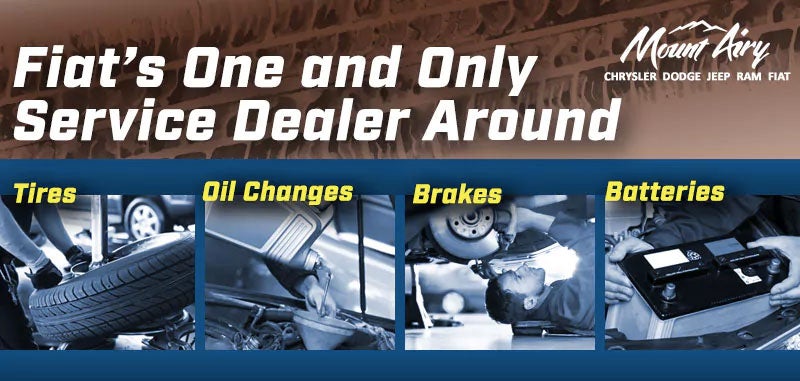
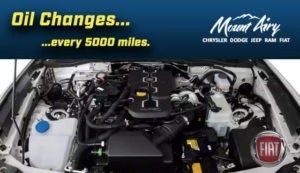 Timely oil changes are crucial to keeping your Fiat running as it should. If the oil is not changed regularly, major problems can occur. We recommend having an oil change every 5,000 miles. Depending on how you drive, however, this estimation can change. If you find yourself mostly in stop-and-go traffic, you might consider changing the oil before it gets to 5,000 miles. On the other hand, driving long stretches on the highway generally wears better on your car and it is possible to go longer before getting an oil change.
Moreover, most new cars use synthetic oil, which lasts longer and works much better than regular oil. Though synthetic costs more (up to three times as much) than regular oil, you don’t have to get it changed nearly as often, so the cost can even out. Your Fiat likely uses synthetic oil and it will need to be changed around every 5,000 to 7,000 miles. Your best bet is to pop in to Mount Airy’s Fiat Service Department. After a quick conversation about your driving habits and a look under the hood, our technicians will give you the perfect diagnosis for prime oil changing upkeep.
Battery Lifespan
Timely oil changes are crucial to keeping your Fiat running as it should. If the oil is not changed regularly, major problems can occur. We recommend having an oil change every 5,000 miles. Depending on how you drive, however, this estimation can change. If you find yourself mostly in stop-and-go traffic, you might consider changing the oil before it gets to 5,000 miles. On the other hand, driving long stretches on the highway generally wears better on your car and it is possible to go longer before getting an oil change.
Moreover, most new cars use synthetic oil, which lasts longer and works much better than regular oil. Though synthetic costs more (up to three times as much) than regular oil, you don’t have to get it changed nearly as often, so the cost can even out. Your Fiat likely uses synthetic oil and it will need to be changed around every 5,000 to 7,000 miles. Your best bet is to pop in to Mount Airy’s Fiat Service Department. After a quick conversation about your driving habits and a look under the hood, our technicians will give you the perfect diagnosis for prime oil changing upkeep.
Battery Lifespan There is some leeway on which type of battery you can put in your Fiat, but no matter what choice you make, you can always extend a battery’s life. The average battery usually lasts as long as four to six years, but this can change depending on how well you take care of your Fiat. Here are a few things you can do to extend your battery’s lifespan:
 Choosing tires for your Fiat can be tricky. Price is definitely a factor, as well as overall quality. Before you go spending top dollar though, it’s best to check with the professionals. We can guide you towards the best tire for how you drive. Once you purchase new tires, you will need to do a few things regularly in order to keep your rides smooth and free from blowouts:
 Bringing your vehicle into Mount Airy Chrysler Dodge Jeep Ram Fiat on a regular basis will keep it running efficiently and save you money in the long run. By letting us take care of your oil changes and tire needs, or just reaching out to our technicians with any of your vehicle maintenance questions, we will equip you with everything you need to keep your Fiat running smoothly. We believe that the effort and care you put into your Fiat (or any vehicle) to make it last, will result in just that—a well-maintained vehicle you will enjoy for years to come.
If you need any more convincing, check out the top 5 reasons to own a Fiat!
-Andrae Bergeron
CCP Web Design
Content Writer
Bringing your vehicle into Mount Airy Chrysler Dodge Jeep Ram Fiat on a regular basis will keep it running efficiently and save you money in the long run. By letting us take care of your oil changes and tire needs, or just reaching out to our technicians with any of your vehicle maintenance questions, we will equip you with everything you need to keep your Fiat running smoothly. We believe that the effort and care you put into your Fiat (or any vehicle) to make it last, will result in just that—a well-maintained vehicle you will enjoy for years to come.
If you need any more convincing, check out the top 5 reasons to own a Fiat!
-Andrae Bergeron
CCP Web Design
Content Writer