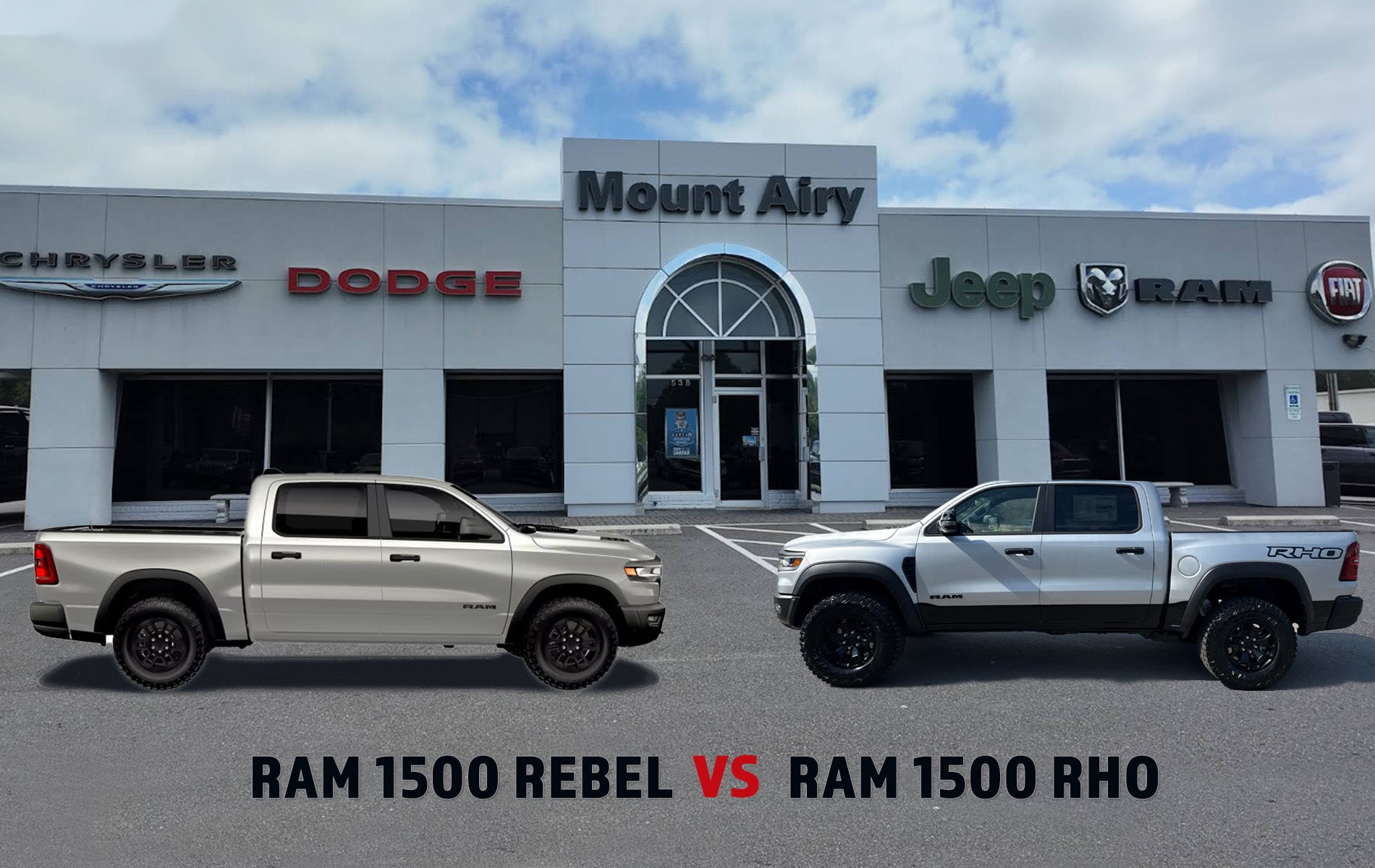
The 2026 RAM 1500 Rebel and the 2026 RAM 1500 RHO are both built for outdoor adventure, but they target very different types of truck buyers. The Rebel is designed to balance daily driving with camping trips, towing, mountain travel, and weekend off-roading throughout North Carolina. The RHO takes things much further, combining premium luxury with aggressive off-road capability, advanced suspension technology, and high-speed dirt-road performance. Both trucks can handle muddy backroads, mountain trails, fishing trips, and rough weather with confidence. The real question is whether the RHO’s added performance and technology justify the higher price for the way you actually plan to use your truck.
For some buyers, the Rebel will be the smarter all-around adventure vehicle. For others, the RHO delivers a level of capability and refinement that few factory trucks can match. Dirt Road Performance vs Everyday Adventure In North Carolina, most off-road truck owners are not racing across desert dunes. They are driving gravel mountain roads near Boone and Blowing Rock, pulling campers through muddy campground entrances, navigating forest service roads, and heading to fishing spots deep in the Appalachians. That is where the differences between the Rebel and the RHO start to matter. The Rebel is designed to comfortably balance daily driving with weekend outdoor adventure, while the RHO is engineered for more aggressive off-road capability, advanced suspension performance, and premium refinement on rough terrain. Suspension Differences: Bilstein Technology Matters The suspension setup is one of the largest differences between these trucks.
The Ram Rebel uses a proven off-road suspension with Bilstein shocks and a factory lift that delivers excellent ride quality on pavement while still handling rough trails comfortably. The RHO takes suspension technology much further.
It uses the advanced Bilstein Black Hawk e2 adaptive shock system, which constantly monitors: Steering input Throttle position Terrain conditions Vehicle movement The system automatically adjusts damping in real time to help keep the truck stable, controlled, and comfortable across changing terrain conditions.
This gives the RHO an incredibly controlled ride over rough dirt roads, washboard surfaces, and uneven terrain.
One of the most surprising things reviewers consistently mention is how refined the RHO still feels on the highway despite its aggressive off-road hardware. Truck Width, Garage Fit, Height Clearance, and Everyday Usability The RHO’s wider stance, 35-inch tires, and aggressive fender flares create incredible road presence, but they can also make: Garage fit tighter Parking decks more stressful Narrow mountain roads trickier Daily maneuvering slightly more challenging The Rebel is still a full-size truck, but its slightly narrower setup and 33-inch tires make it feel more manageable in suburban neighborhoods, older garages, and mountain-town environments. For buyers in North Carolina, garage fit is worth considering before purchase, especially in older homes where garage dimensions may be smaller than modern standards. Measurement Ram Rebel Ram RHO Average 1-Car Garage Average 2-Car Garage Width (Without Mirrors) 82.1 inches 88 inches 144 inches wide 240 inches wide Remaining Width Clearance 61.9 inches 56 inches — — Clearance Per Side 30.95 inches 28 inches — — Approximate Height 77.6 inches 80.9 inches 84-inch garage opening 84-inch garage opening Remaining Height Clearance 6.4 inches 3.1 inches — — Many truck owners online mention that rooftop tents and 35-inch tire setups can quickly create clearance problems with garage doors and parking decks.
For buyers planning future camping or overlanding upgrades, the Rebel’s slightly lower stance may offer more flexibility for everyday garage use, while the RHO delivers a much more aggressive appearance and commanding off-road presence. Ground Clearance Differences Ground clearance matters more than many buyers realize, especially on uneven forest roads, muddy campsites, and rocky mountain access trails.
Approximate ground clearance: Ram Rebel: 9.7 inches Ram RHO: 11.8 inches The additional clearance on the RHO helps protect the underbody during more aggressive off-road driving and allows the truck to clear obstacles more easily.
Still, the Rebel offers more than enough clearance for most camping, fishing, and outdoor travel situations throughout North Carolina and Virginia. Camping Features and Rooftop Tent Compatibility Both trucks can absolutely become excellent camping and overlanding rigs.
The Rebel may actually be the easier and more affordable platform for many camping enthusiasts because owners often feel more comfortable modifying it with: Rooftop Tents | Bed Racks | Cargo Systems | Recovery Gear | Camping Accessories | Split Tailgate The RHO can certainly handle rooftop tents and overlanding setups, but many buyers hesitate to heavily modify such an expensive high-performance truck.
Because the Rebel sits slightly lower and uses smaller tires, rooftop tent access can also feel a little easier for everyday camping use.
Both trucks offer large bed space, power outlets, towing capability, cargo flexibility, and strong aftermarket support for outdoor adventure builds. The Hurricane Twin-Turbo Engine Explained One of the biggest differences between the Rebel and the RHO is the version of Ram’s new Hurricane twin-turbo inline-six engine used in each truck. Feature RAM Rebel RAM RHO Engine 3.0L Hurricane Twin-Turbo Inline-6 High-Output 3.0L Hurricane Twin-Turbo Inline-6 Horsepower 420 HP 540 HP Torque 469 lb-ft 521 lb-ft Driving Characteristics Balanced power for towing, daily driving, and outdoor adventure Extreme acceleration and aggressive off-road performance Power Delivery Smooth low-end turbo torque with strong everyday responsiveness Massive turbocharged torque with high-performance tuning and rapid acceleration Fuel Efficiency Compared to Older V8s Improved efficiency with strong towing capability Better efficiency than previous high-output V8 performance trucks The power delivery in both trucks feels very different from older naturally aspirated V8 trucks. Turbocharged torque arrives quickly and smoothly, making both the Rebel and the RHO feel responsive even at lower RPMs. The Rebel focuses more on balanced everyday usability, while the RHO delivers significantly more aggressive acceleration and high-performance driving characteristics. Interior Comparison: RAM Rebel vs RAM RHO The interior differences between the Rebel and the RHO become much more noticeable once you get inside the truck. While both models offer modern technology, large touchscreens, and premium comfort features, the RHO pushes further into luxury-truck territory with more upscale materials and high-end technology. Feature RAM Rebel RAM RHO Interior Characteristics Rugged, practical, outdoor-focused Premium, high-tech, luxury-oriented 12-Inch Touchscreen Standard or available depending on trim Standard 14.5-Inch Touchscreen Not typically available Available / Often equipped Passenger Interactive Display Not available on most Rebel configurations Available option Massaging Front Seats Not available Available option Leather / Suede Seating Available depending on package Standard or commonly equipped Harman Kardon Premium Audio Available option Available / Frequently equipped Carbon Fiber Interior Accents Not typical Available Advanced Driver Assistance Features Available depending on package More comprehensive package availability Everyday Driving Comfort Excellent balance of comfort and utility Luxury-truck comfort with aggressive off-road capability Rebel Interior with Red Accents RHO Interior Luxury Comfort Seats The Rebel still offers impressive comfort and technology for everyday driving, camping trips, towing, and mountain travel. The RHO simply adds another level of premium materials, advanced technology, and luxury-focused features for buyers wanting a more upscale off-road truck experience. Which Truck Is More Appropriate for North Carolina Mountain Driving? North Carolina mountain driving presents very different challenges than wide-open off-road terrain. Drivers regularly deal with tight winding roads, steep elevation changes, gravel backroads, heavy rain, occasional snow, and narrow campground or trail entrances throughout the Appalachians. These conditions make everyday maneuverability, suspension comfort, traction, and overall truck size especially important when deciding between the Ram Rebel and the more aggressive Ram RHO.
For many buyers, the Rebel may feel easier to maneuver every day because it is slightly less aggressive in overall width, tire size, and ride height. The RHO shines on rough dirt roads and uneven terrain where its advanced suspension system can fully show its capabilities. Buyers whose lifestyle includes long mountain drives, towing campers, rough access roads, outdoor recreation, and daily commuting may find the Rebel offers the better overall balance of comfort, practicality, and capability. Buyers looking for maximum off-road performance, premium luxury, aggressive styling, and trophy-truck-inspired characteristics will likely find the RHO far more appealing. Bed Utility and Tailgate Features Both the Ram Rebel and the Ram RHO are designed to handle outdoor gear and active lifestyles, whether you are loading fishing equipment, coolers, camping supplies, mountain bikes, kayaks, or towing accessories.
Both trucks come standard with: Bed lighting Trailer towing technology Trailer assistance features Multiple cargo tie-down points Easy-access tailgate functionality Available features on both trucks, depending on configuration and option packages, may include: Power outlets in the bed Adjustable cargo management systems Spray-in bedliners Power tailgate functionality Advanced trailer camera systems Ram’s tailgate design remains one of the most practical in the truck industry, especially for loading heavier outdoor equipment and camping gear. Buyers planning to tow boats, campers, or outdoor trailers will find both trucks highly capable, although the Rebel may appeal more to buyers prioritizing towing balance while the RHO leans further toward premium off-road performance. Recovery Points and Skid Plates Recovery points and skid plates are two of the most important features on a serious off-road truck, especially for drivers exploring mountain roads and remote outdoor areas in North Carolina. Recovery points, often called tow hooks or recovery hooks, provide secure attachment locations for tow straps, winches, or recovery gear if a truck becomes stuck in mud, snow, loose gravel, or uneven terrain. They are especially valuable on steep mountain trails, muddy campground entrances, and rough forest service roads where traction conditions can change quickly. Skid plates are heavy-duty protective panels mounted underneath the truck to help shield critical components like the engine, transmission, fuel tank, and transfer case from rocks, ruts, tree stumps, and rough terrain. In mountain environments with uneven access roads and hidden obstacles, skid plates can help prevent extremely expensive damage underneath the vehicle.
Both the Ram Rebel and the Ram RHO come equipped with serious off-road protection. Depending on configuration, buyers may find: Skid plates Tow hooks and recovery points Locking rear differentials Off-road drive modes Upgraded transfer cases The RHO takes things further with more aggressive underbody protection and additional suspension travel designed for higher-speed off-road capability and rough terrain performance.
The Rebel remains extremely capable for the type of driving most North Carolina truck owners are realistically doing, including muddy trails, hunting property access roads, mountain travel, snow, and campground or fishing access roads throughout the Appalachian region. Towing Comparison One surprise for many buyers is that the Rebel can actually out-tow the RHO when properly configured.
Approximate towing capacity: Rebel: Up to 11,140 lbs RHO: Around 8,360 lbs That matters for buyers towing: Campers Fishing boats Enclosed trailers Side-by-sides Outdoor equipment The RHO prioritizes suspension travel and high-speed off-road performance, while the Rebel retains stronger towing flexibility for many real-world truck owners. Choose the RAM Rebel if you want: Choose the RAM RHO if you want: Everyday practicality Strong towing capability Outdoor adventure versatility Easier mountain driving Better garage friendliness Lower ownership cost Balanced daily comfort A more manageable everyday driving experience Maximum off-road performance Premium luxury features Advanced adaptive suspension Factory 35-inch tires Trophy-truck-inspired characteristics High-speed dirt-road capability A more aggressive off-road appearance One of the most advanced Ram trucks ever built For many North Carolina buyers, the Rebel may ultimately be the smarter all-around adventure truck thanks to its balance of comfort, practicality, towing capability, and everyday usability. However, buyers looking for the ultimate Ram off-road experience will find that the RHO delivers an impressive combination of power, luxury, suspension technology, and aggressive off-road capability that few factory trucks can match.