



Mount Airy Chrysler Dodge Jeep Ram FIAT

Blog / Safety

Blog

All Safety New Inventory Jeep RAM Trucks Dodge Chrysler Service About Mount Airy CDJRF Pre-Owned Inventory Electric Vehicles News Fiat Mount Airy Chrysler Dodge Jeep Ram FIAT Service Mount Airy Chrysler Dealer Used Cars Trade In Community Events Finance Hybrid Jeep Compass Jeep Wagoneer Jeep Wrangler New Technology Accessories Jeep Gladiator Jeep Grand Cherokee People Christmas Year End Sales Minivans Mount Airy Used Cars Black Friday Commercial Trucks & Vans Jeep Trim Levels Mount Airy Chrysler Service
Chrysler Dodge Jeep Ram FIAT Fuel Guide

Know Your Fuel Options: Get the Most Out of Your Chrysler, Dodge, Jeep Ram & Fiat

If you've ever had someone swear by premium fuel, or have a vehicle enthusiast in the family, you've probably had a debate or two at the gas pump. Some people believe premium gasoline is always better. Others won't spend a penny more than they have to. So, who's right? The answer is... both. Unlike many manufacturers that recommend the same fuel for nearly every vehicle, the Chrysler, Dodge, Jeep, Ram and FIAT family includes everything from fuel-efficient commuter vehicles and work trucks to high-performance muscle cars, luxury SUVs, diesel trucks and fully electric vehicles. That means the right fuel depends on what you're driving. The good news is that choosing the correct fuel isn't nearly as complicated as it looks when you're standing at the pump. The Best Fuel Isn't Always the Cheapest... or the Most Expensive One of the biggest misconceptions in the automotive world is that premium gasoline is simply "better" gasoline.  It isn't. Premium fuel isn't cleaner. It doesn't contain more energy. It doesn't automatically make your engine last longer. Instead, the best fuel is the fuel your vehicle's engineers designed it to use. Putting premium gasoline in a Jeep Compass usually won't make it perform any better. On the other hand, putting regular gasoline into a Wrangler 392 or another high-performance engine isn't doing it any favors.  Think of fuel like prescription medicine. The correct prescription works best. Taking more doesn't necessarily improve the results. A Simple Guide to Fuel Recommendations Fortunately, choosing the correct fuel doesn't have to be confusing. Fuel Type Typical Chrysler, Dodge, Jeep, Ram, Fiat Vehicles 87 Regular Unleaded Most Jeep Compass, Cherokee, Wrangler, Gladiator, Grand Cherokee V6, Chrysler Pacifica, Ram 1500 Pentastar V6, Ram ProMaster, FIAT 500L 89 Mid-Grade Many HEMI® V8-powered Ram trucks and Dodge/Jeep SUVs 91+Premium Wrangler 392, SRT® models, Grand Wagoneer Hurricane, Ram 1500 Hurricane High Output, FIAT 500X, FIAT 500 Abarth, FIAT 124 Spider Ultra Low Sulfur Diesel (ULSD) Ram 2500 & 3500 Cummins® Turbo Diesel trucks, EcoDiesel-equipped Jeep and Ram model s Electricity Jeep Recon, Wagoneer S, FIAT 500e Important: Always check your owner's manual and the label inside your fuel door for your specific vehicle. Different engines and trim levels can have different fuel recommendations. Why Do Some Vehicles Need Premium Fuel? This is where many people get confused.  Premium gasoline isn't designed to make an engine more powerful.  Instead, it helps prevent engine knock in engines that produce very high cylinder pressures. For example, a Jeep Compass develops around 200 horsepower and is engineered to run efficiently on regular 87-octane gasoline.  Compare that to a Wrangler 392 with its legendary 6.4-liter HEMI V8 producing approximately 470 horsepower, or the new Grand Wagoneer equipped with Stellantis' twin-turbo Hurricane engine producing well over 500 horsepower.  Those engines generate dramatically higher combustion pressures, requiring gasoline with greater resistance to premature combustion. That's exactly what premium fuel provides. Premium gasoline isn't a luxury.  It's simply the correct fuel for certain high-performance engines. What Is Octane? Octane is one of the most misunderstood words you'll see at the gas station.  Here's the simple explanation: Octane measures a gasoline's resistance to premature combustion inside the engine. Higher octane does not mean: More horsepower Better quality gasoline Cleaner fuel Longer engine life It simply means the fuel is better suited for engines designed to operate under higher pressures.  That's why so many Chrysler, Dodge, Jeep and Ram vehicles are perfectly happy using regular gasoline, while certain HEMI®, Hurricane and SRT® engines are engineered for premium fuel. What About Mid-Grade Gasoline? Many HEMI-powered trucks and SUVs recommend 89-octane mid-grade gasoline. Can they operate on 87?  In many situations, yes.  Modern engine computers can adjust ignition timing to compensate for lower octane.  However, using the recommended 89-octane fuel allows the engine to perform as its engineers intended, especially while towing, climbing mountains or accelerating under heavy loads. If your owner's manual recommends 89 octane, that's still the best choice. Diesel Is a Completely Different Fuel Ram's legendary Cummins® Turbo Diesel trucks don't use gasoline at all.  They require Ultra Low Sulfur Diesel (ULSD). Diesel engines ignite fuel differently than gasoline engines.  Gasoline engines use spark plugs.  Diesel engines ignite fuel through extremely high compression.  Because of this completely different design, gasoline should never be pumped into a diesel vehicle, and diesel should never be pumped into a gasoline-powered vehicle. What Happens If You Accidentally Put Diesel Into a Gasoline Vehicle? It happens more often than you might think. If you accidentally pump diesel into your gasoline-powered vehicle: Don't start the engine. If the mistake is caught before starting the vehicle, repairs are often limited to draining the fuel tank and flushing the fuel system. Once the engine has been started, diesel fuel can circulate through the injectors, fuel lines and spark plugs, increasing the cost of repairs. The sooner the mistake is discovered, the better. What About FIAT Vehicles? Although FIAT models make up a smaller portion of our inventory, they follow exactly the same rule as every other vehicle we sell.  Use the fuel recommended by the manufacturer. Some FIAT models, including the FIAT 500X, FIAT 500 Abarth and FIAT 124 Spider, feature turbocharged performance engines that recommend premium gasoline to deliver their intended performance.  Others, like the FIAT 500L, are engineered to operate on regular 87-octane gasoline.  The all-electric FIAT 500e doesn't visit the gas station at all. Once again, the best fuel isn't the most expensive fuel—it's simply the fuel your vehicle was designed to use. Buying a Used Vehicle? Don't Guess. One advantage of shopping at Mount Airy Chrysler Dodge Jeep Ram FIAT is the variety of vehicles we offer. That also means fuel recommendations can vary significantly from one vehicle to another. For example: A used Jeep Grand Cherokee with the Pentastar V6 uses different fuel than a Grand Cherokee SRT. One Dodge Charger may be perfectly happy on regular gasoline, while another equipped with a high-performance engine recommends premium. One Ram 1500 may use regular gasoline, while another with the new Hurricane High Output engine performs best on premium. A used FIAT 500L and a FIAT 500 Abarth have different fuel recommendations, even though they're both FIAT vehicles. Don't assume every vehicle from the same manufacturer uses the same fuel.  When in doubt, check the owner's manual, look inside the fuel door or ask one of our product specialists.  We're always happy to help. Fuel Quality Matters, Too Regardless of the octane rating, we recommend purchasing fuel from reputable stations that sell Top Tier™ Detergent Gasoline whenever possible.  Top Tier gasoline contains enhanced detergent additives that help reduce deposits on fuel injectors, intake valves and combustion chambers, helping modern engines stay cleaner over time.  It's one of the easiest ways to help protect your investment. In Summary ... Many Chrysler, Dodge, Jeep, Ram and FIAT vehicles are engineered to run perfectly on regular 87-octane gasoline. Some HEMI-powered vehicles perform best on 89-octane mid-grade. High-performance vehicles like the Wrangler 392, SRT models, Grand Wagoneer Hurricane, certain Hurricane-powered Ram trucks and several FIAT performance models are designed for premium gasoline. Diesel trucks require Ultra Low Sulfur Diesel. Electric vehicles don't require gasoline at all. The important thing isn't buying the most expensive fuel. It's buying the right fuel for the vehicle you're driving.  If you're ever unsure, stop by Mount Airy Chrysler Dodge Jeep Ram FIAT. Our team will gladly help you identify the correct fuel for your vehicle, explain why it's recommended and answer any questions you may have.  Because getting the most out of your vehicle starts with putting the right fuel in the tank.
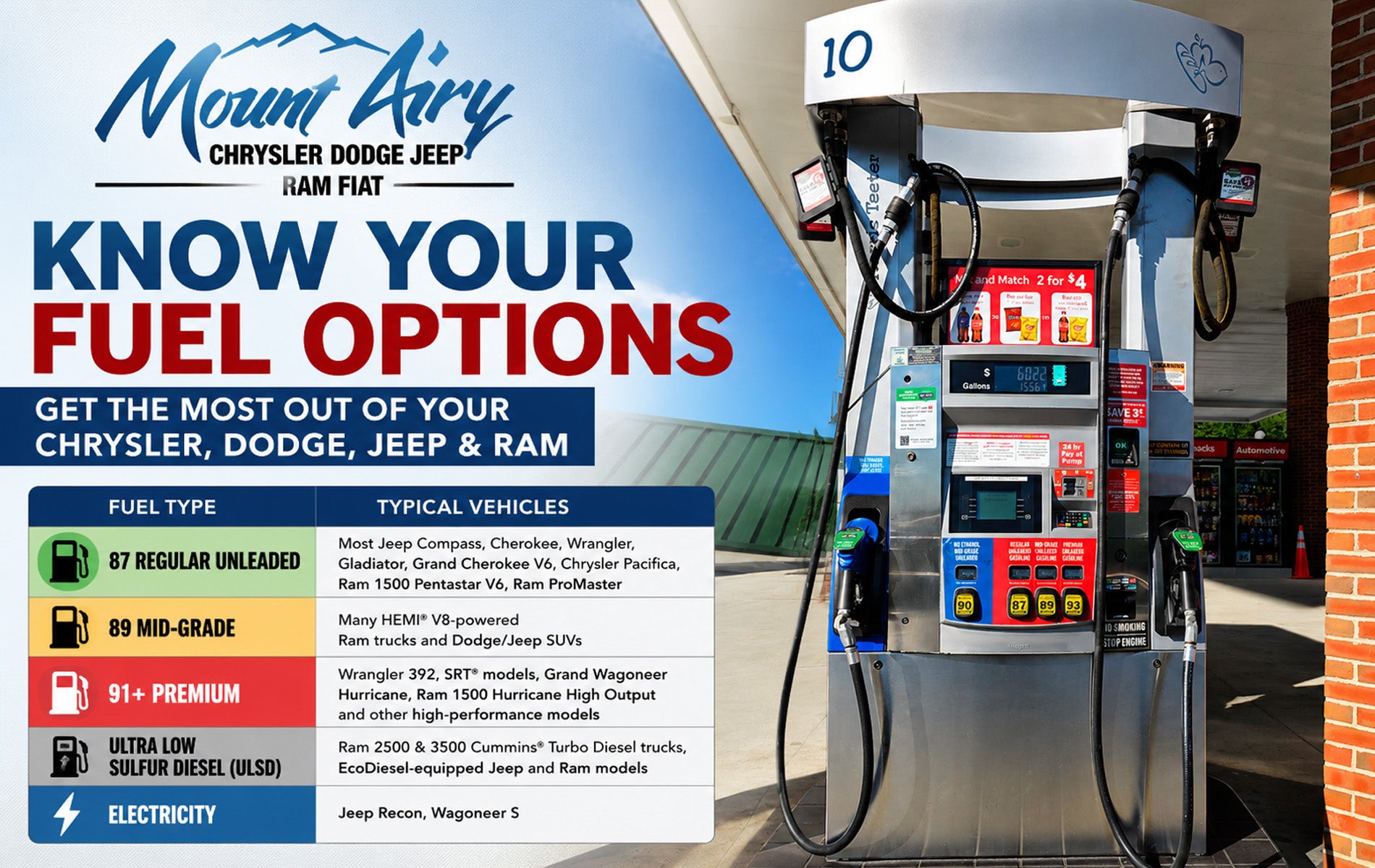
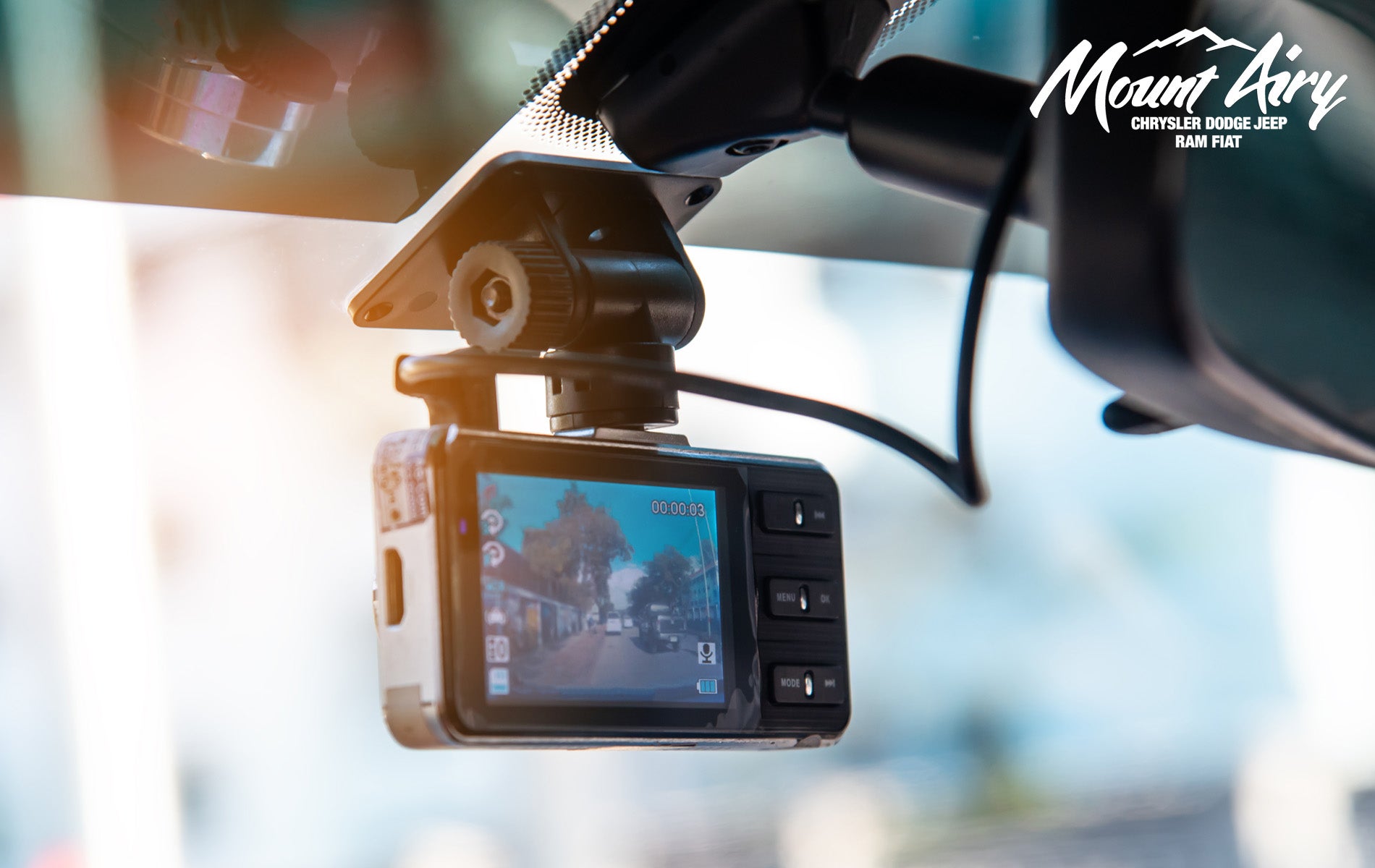
A running camera can deter theft, vandalism, and accidents on the road.

The Usefulness of Dash Cams–And The Best Types To Purchase

We’ve all seen dash cams in cars before, but what is their purpose? Why would anyone want a recording of their driving? Come to find out, there are multiple purposes for using dash cams, and all of them are important–important enough that every driver today should have one installed. In the modern age of driving, having a recording of your trips (or accidents, speeding tickets, etc.) can be incredibly beneficial. Let’s see why. Exactly What is a Dash Cam? A dash cam is a small camera that is mounted to your vehicle’s dashboard, windshield, or rear-view mirror, and its primary function is to record video footage of your trip, as short or as long as it may be, to provide you with a visual record of all the events that took place during the drive. The camera connects to your car’s power supply and it begins recording right at the start of your trip, and it stores the recorded footage on a memory card or some other device that is easily removable. Once your drive and the recording are finished, you can access and review any of the recordings at any time. One of the many things that’s nice about dash cams is that they all come with a variety of features. GPS tracking, night vision, audio recording–these are only a few of the available functions used to provide you with a more comprehensive look at your travels. Imagine the protection against fraud, the deterrent for reckless driving, and even the capability of making memories this one device can offer. Now that we know what a dash cam is and what it does, let’s look into why you should own one. Is It Truly Worth The Purchase? In short, yes. Absolutely it is. Dash cams are invaluable for drivers. This tool can provide valuable evidence for settling insurance claims and even settling legal disputes in the event of a car accident. Moreover, a dash cam can protect you from fraud by recording particular incidents that happen on the road, like staged/phony accidents and false insurance claims. Think of how nice it would be for parents of teen drivers to have a dash cam recording that allows you to monitor their driving behaviors. Your teen might be more apt to follow the rules of the road a bit more conscientiously if they know mom and dad are watching! Another great reason to install a dash cam is to capture those beautiful drives through scenic mountains, forests, etc. With your dash cam, you can record it all. What Are The Different Types of Dash Cams? There are a lot of dash cams to choose from. Do a quick Amazon search and you will be inundated with cams all offering different features and capabilities. Here are a few of our favorite types of dash cams along with a quick description of what they can do: Single Channel Dash Cams These are the most basic type to purchase, as they only record footage from the front of the car. Since they have one, primary function these are usually the most affordable option, and they work well for drivers who only need a basic recording of the events that took place in the front of their vehicle. You can purchase a single-channel cam for around $100. Dual Channel Dash Cams Dual-channel cams offer footage from both the front and the rear of the car, which makes them a great choice for drivers who want a recorded view of their travels. It’s true most of the action takes place up front, but there can be plenty happening behind you as well. Not a bad idea to get the front and rear view. Dual-channel dash cams come at around $200-$300, depending on the brand. 4K Dash Cams 4K dash cams provide drivers with a high-definition video recording. The footage a 4K captures is incredibly clear and detailed without blemish and is a must for anyone who knows they will be coming across a scene they will want to be recorded with wonderful clarity. To nobody’s surprise, this type of dash cam is a bit more expensive, running anywhere from $375 to $500. Rear-View Mirror Cameras Cameras that mount to your car’s rear-view mirror seamlessly blend into the interior, so passengers might not even notice it if you don’t share that you have one. These types of cameras are made to discreetly provide a recording without interfering with your view of the road, as well as, the car’s natural aesthetic. This mirror cam most often comes with a larger screen that can display a live feed of your surroundings, and you can check your footage as you drive. *A quick note on lithium-ion and capacity battery-powered dash cams: lithium-ion and supercapacitor are the two most commonly used dash cam battery types. Both have their good and not-so-good aspects, mostly depending on how they are used, but we have found that the supercapacitor is more efficient, as it tends to have a longer running life due to its ability to work under extreme heat and cold weather conditions. Even More Benefits of Having a Dash Cam Personal security is one of the best reasons to drive with a dash camera. A running camera can deter theft, vandalism, and accidents on the road. Some even offer a parking feature that allows drivers to monitor the vehicle’s surroundings while the car is parked and left alone. Safety is a reason alone that dash cams are flying off the shelf, especially during the holiday season and times of high travel and therefore high theft. The ability to have video evidence at the ready is a wonderful way of safekeeping video evidence you have captured of a crime or car accident. This evidence is an incredibly valuable asset to use in any sort of legal proceedings, as it can dispute against fraudulent insurance claims–something we see happening way too often these days. Businesses have even turned to dash cams as a way of encouraging and monitoring safe driving (think delivery trucks and various taxi services). Could there be a better way to keep drivers aware of their actions and driving behaviors than installing a dash cam? We think not. You can consider your dash cam as another set of eyes on the road, working in tandem with you to make sure your travels are safe. With this added layer of security, drivers can feel more confident knowing their journey is being recorded and anything captured can be seen and used as needed. Anyone who travels often or who spends copious amounts of time on the road (for work or pleasure), certainly should have a dash cam. They can be used to capture interesting images, scenic footage, or as mentioned above save you from entering into dangerous situations. Consider purchasing a dash cam today, and start recording your travels, no matter how big or small.

Driver safety technologies are a marvel when used responsibly

The Intersection of Safety Features and Distracted Driving in North Carolina (and Beyond)

Distracted driving is a pressing issue affecting everyone on the road. As we traverse the picturesque highways and bustling urban arteries of the Tar Heel State, the perils of divided attention demand our attention. While the dangers of texting or tinkering with our devices while driving are well-documented, another facet of this dilemma often flies under the radar: the potential distraction posed by modern safety features in our vehicles. Below, Mount Airy Chrysler Dodge Jeep Ram Fiat navigates the complexities of distracted driving in North Carolina, where even the tools meant to bolster our safety can inadvertently divert our focus from the task. Here’s a preview of the technologies we’ll discuss: Voice-activated controls are intended to reduce manual distractions, but voice commands still require cognitive attention and can potentially divert focus from the road. Adaptive Cruise Control (ACC) can reduce the need for constant speed adjustments but might lead drivers to rely too heavily on the system and become less attentive. Lane Departure Warning (LDW) and Lane Keeping Assist (LKA) are designed to prevent accidents caused by drifting. The problem is that these systems may encourage drivers to pay less attention to their actual lane positioning. Blind Spot Monitoring (BSM) is helpful for improving awareness, but relying solely on this system can cause drivers to overlook traditional shoulder checks. Automatic parking assistance helps drivers park parallel or perpendicularly. Though convenient, some drivers become overly reliant on this technology and miss important details in the process. Collision avoidance systems are known to mitigate accidents; that said, drivers can become complacent in their driving behavior and assume the system will always intervene. NC in the News Winston-Salem has recently garnered national attention for an unfortunate distinction: being labeled the most dangerous city in the United States for driving during rush hour. Not surprisingly, the designation has sparked concern among residents and officials alike, prompting a closer examination of traffic safety measures and enforcement in the area.   Data from both national and North Carolina sources has revealed another critical statistic: the period between 9 p.m. and 11:59 p.m. on Friday or Saturday nights is the most dangerous time to be on the road. There’s a genuine need for heightened awareness and proactive measures to address the specific challenges of nighttime driving, particularly during weekends.   Some transportation experts and journalists have suggested distracted driving as a leading cause of these late-night fatalities. As communities grapple with these concerning trends, concerted efforts to improve road safety and reduce traffic-related incidents are paramount. 6 Potentially Dangerous Safety Technologies So, how can we play our part in keeping the roads safe? The key is to get in the habit of using today’s stellar driver safety technology without letting it divert our attention. Let’s take a look at the features most likely to enable distracted driving: 1. Voice-Activated Controls Picture this: You're cruising down the highway, wind in your hair (or blasting A/C), and you realize you forgot to change the music. With voice-activated controls, you can just say the magic words and your favorite tunes start jamming without ever taking your eyes off the road. It's like having a personal assistant right in your car. These nifty features aren't just reserved for the luxury rides. Many modern vehicles are equipped with voice-activated controls for navigation, entertainment, and climate control systems. Voice commands are supposed to make life easier and safer on the road. After all, keeping your hands on the wheel and eyes on the prize is a top priority. But even if you're not physically tapping away on buttons, using your voice demands a chunk of your attention. You're belting out your favorite tune and trying to tell your car to crank up the A/C — all while navigating rush hour traffic. That's a lot going on in your noggin. And as much as we'd like to believe we're master multitaskers, our brains can only handle so much at once. Voice commands may seem like the answer to all your road trip prayers, but they could also be pulling your focus away from the road ahead. Fortunately, there’s a silver lining. Like any tool, it's all about how you use voice commands. If you're blasting music on an open highway with nothing but tumbleweeds for company, you’re probably safe to command away. But if you're navigating a maze of city streets during rush hour, maybe hold off on switching up that playlist until you hit a red light. 2. Adaptive Cruise Control (ACC) Adaptive Cruise Control (ACC) is like your car's personal traffic butler, automatically keeping a safe distance from the vehicle in front of you. However, as with all good things, there's a catch. While ACC can take some of the load off your shoulders, some folks start relying on it too much, zoning out or getting distracted by that tempting playlist or scenic view. Consider cruising down the highway. Everything's smooth sailing, and suddenly, the car ahead slams on the brakes. ACC is there, doing its thing, but you're off in la-la land—perhaps checking your phone or daydreaming about dinner. The outcome probably won’t make you friends with the driver you're tailgating! ACC is fantastic for taking the edge off those long drives, but it's not an excuse to switch off your brain. Keep your eyes on the road and hands on the wheel, and save the daydreaming for when you're safely parked. 3. Lane Departure Warning (LDW) and Lane Keeping Assist (LKA) As the name suggests, Lane Departure Warning (LDW) and Lane Keeping Assist (LKA) represent two significant safety features. LDW serves as a preemptive alert system, signaling drivers when their vehicle begins to unintentionally veer out of its designated lane. LKA provides an active response by autonomously steering the car back into its proper lane alignment. These systems undoubtedly offer invaluable assistance in mitigating the risk of accidents resulting from unintentional lane departures. That said, there’s a notable concern regarding their potential to foster complacency among drivers. Some people become overly reliant on LDW and LKA, which diminishes their attentiveness to maintain precise lane positioning. Consider the scenario of a driver navigating a highway with LDW regularly emitting alerts at the slightest deviation from the lane's center. Over time, the driver might develop a false sense of security and assume that the technology will perpetually compensate for all lapses in attention or adherence to lane discipline. As with the other technologies on this list, LDW and LKA are not a substitute for sustained driver attentiveness and adherence to safe driving practices. We must remain mindful of our responsibility to stay vigilant and engaged when operating a vehicle to keep ourselves and those around us safe. 4. Blind Spot Monitoring (BSM) Blind Spot Monitoring (BSM) is like having an extra set of eyes on the road. It's a nifty system that employs sensors to keep tabs on vehicles lingering in those pesky blind spots. For example, if there's a car hiding in your blind spot, BSM springs into action and gives you a heads-up through alerts. It can save you from potential sideswipes and fender-benders.   While BSM is great for boosting awareness, don’t think of it as a magic fix. Relying solely on this tech inadvertently encourages some drivers to abandon traditional shoulder checks. A quick glance over your shoulder is still an effective strategy for blind spot detection, especially when coupled with BSM. In other words, BSM is your trusty sidekick, not the hero of the story. Cover your bases to keep that safety net intact. 5. Automatic Parking Assistance Automatic parking assistance eliminates the hassle of parallel or perpendicular parking. Say, for instance, you're cruising down a busy street and eyeing that perfect parking spot, but the thought of maneuvering into it makes you break out in a cold sweat. This features takes control of the steering so you can focus solely on the gas and brake pedals. It's almost like having a parking fairy godmother guiding you into that tight spot as you sip your coffee peacefully. Automatic parking assistance is undoubtedly convenient, but there's a risk of becoming too reliant on it. You use it once, then twice, and suddenly you're wondering how you ever parked without it. Relying too heavily on this technology might cause you to miss out on crucial details during the parking process. You might overlook that fire hydrant lurking just inches away or fail to notice the curb creeping up on your bumper. Remember that this feature is meant to assist, not replace, your parking skills. Keep your eyes peeled and use a little extra caution when parking in tight spots. 6. Collision Avoidance Systems Collision avoidance systems incorporate sensors and cameras to detect potential collisions; they may automatically apply brakes or alert drivers to take evasive action. Although effective in mitigating accidents, it’s easy to develop complacency and assume the system will always intervene. These systems act as an additional set of eyes on the road to anticipate potential collisions. If a vehicle swerves into your lane, the collision avoidance system springs into action by applying brakes or prompting you to take control. However, some drivers fall into the trap of thinking, "The car will handle it," neglecting their responsibility behind the wheel. While these systems serve as safety nets, remember that you’re ultimately in charge. Proactive and attentive driving remains the cornerstone of road safety. How To Use Safety Features Properly Driver safety technologies are a marvel when used responsibly. It’s all about harnessing their assistance while maintaining your attentiveness. Here are some key strategies: Independent Driving: Regularly practice driving without relying solely on the assistance of safety technologies to hone your skills and maintain situational awareness. Backup Awareness: Even with safety features like blind-spot monitoring and collision warning systems, always incorporate traditional driving practices (e.g., checking mirrors, looking over your shoulder, using turn signals). Limit Dependency: Avoid becoming overly reliant on safety technologies by consciously using them as aids rather than replacements for attentive driving. Hands-Free Discipline: When using hands-free technology, limit your conversations to essential information. Also, don’t engage in emotionally charged discussions or complex decision-making conversations. Active Engagement: Continuously monitor the road environment even when utilizing hands-free features; that way, you’re prepared to intervene if the situation demands manual control. Regular Evaluation: Periodically assess your reliance on safety technologies and hands-free features to ensure they enhance rather than detract from your ability to drive safely. Modern safety features are designed to enhance road safety but can also pose potential dangers when used incorrectly. As we navigate distracted driving in North Carolina and beyond, it’s imperative to incorporate driver assistance tools without letting them compromise our focus. Vigilance, active engagement, and regular self-assessment are crucial to ensuring these technologies serve as aids rather than substitutes for attentive driving.

Severe Weather Driving in Mount Airy

Severe Weather Season in North Carolina is Here!

If you’ve been watching the news, you know that North Carolina and most of the Southeast are firmly in severe weather season. The Atlantic Hurricane season spans from June 1st to November 30th, with North Carolina’s highest risk in August, September, and October. Families must plan accordingly to stay safe during this time, as severe weather can damage your property and your person. And with recent studies saying that severe weather is more common and likely than ever, knowing just what to do is more important than ever. “ It's a reminder that the risk of extreme events is growing, and they're affecting every corner of the world," - Sarah Kapnick, National Oceanographic and Atmospheric Administration (NOAA). Severe weather isn't just hurricanes; it’s flash floods, heavy rain, lightning, hail, and strong winds — all of which are also more likely during hurricane season. Reliability and preparedness are the most important factors for staying safe and secure during severe weather events. Both of those traits are synonymous with Mount Airy CDJRF’s models and the safety they provide. While we’ll go on to unpack the do’s and don’ts of avoiding danger during the severe weather season, Chrysler, Dodge, Jeep, Ram, and Fiat have many models equipped to deal with whatever is thrown their way. So take on the storms with the best partner there is and visit Mount Airy CDJRF today! Vehicles – Are They Safe During These Events? While we’re on the subject of the right vehicles, knowing if they’re safe during these weather events is vital. So, are they? The short answer is that it depends. Take this quote from the National Weather Service: " Being in a vehicle during severe thunderstorms is safer than being outside; however, drive to closest secure shelter if there is sufficient time.” Take it from the professionals! It’s best to hunker down during events that bring heavy rains, floods, strong winds, and hurricanes. But that’s not always an option. It’s best to get away from whatever is coming towards you, and if there is a strong chance of thunder and lightning, staying in your vehicle in a low-lying area is a great idea. Still, strong storms have been known to trap countless drivers in their cars, waiting for them to pass from once-in-a-lifetime blizzards to heavy rains and thunderstorms that force you to pull over. If you’re in that situation, you want to ensure that your car, truck, or SUV is well-equipped with safety features to make it through whatever is passing. And there is good news there — every new model Mount Airy CDJRF offers the perfect set of safety features to keep you protected! An Unrivaled Set of Safety Features Mount Airy CDJRF offers so many different models and makes that it would be difficult to list every safety feature. However, we’ll do our best to touch on the highlights! Chrysler - Many of the new Chrysler models offer 360-degree camera features, which will keep you aware of your surroundings. Eliminating blindspots is a huge bonus when in a tough situation, like navigating through fallen debris in a storm. See this feature in action on the 2023 Pacifica. "The 2022 Chrysler Pacifica delivers on our firm commitment to provide customers with superior safety," - Chrysler Brand CEO Chris Feuell Dodge - Dodge is a brand that can do it all. Their newer models include a feature known as Hill Start Assist. The Hill Start Assist program can detect when your vehicle isn’t level. The system then uses its brake to prevent rollback or a backslide. This can be the difference between disaster and safety when strong winds, rains, or ice are on the road—keeping you and your passengers stable, even when you’re not level. Find this in the 2023 Durango and other Dodge models. Jeep - Jeeps are known for their toughness, owing to their origins as United States Army vehicles. This makes them one of the best choices during a severe weather event. Jeeps have several crash-prevention properties, notably forward collision warning with active braking. This is one of the most impactful features in preventing crashes and disasters. In the case of a severe weather event with low visibility, it could stop you from hitting debris you otherwise wouldn’t have seen. You can test it yourself on any of the Jeep models at Mount Airy CDJRF! RAM - RAMs are tough, carving that perception out with their many impressive truck models. So, if you find yourself in a RAM, you’ll likely be able to navigate those roads impacted by severe weather. Still, the vehicles offer Rear Path Detection, which can scan the area behind and on the side of the vehicle. Perfect when you have to take an alternate path that’s filled with unknowns. FIAT - The FIAT 500x has several features similar to those we’ve outlined in other models. Most notably, the FIAT has advanced adaptive cruise control, which bases your current speed on the vehicle before you. This ensures you stay a safe distance behind whatever’s ahead while making good time. Other Tips if You Find Yourself In A Severe Weather Situation While the impressive safety lineup you’ll find at Mount Airy CDJRF is an impressive start to staying safe, knowing a few tips will be enough to maximize the protection for you and your passengers. Preparing for any situation is the best way to stay out of trouble! Here are a few important things to know to avoid danger. Ways to Get Out Of Your Car if You Find Yourself In Water- If you encounter standing water that looks high, do not try to drive through it. Never enter water you cannot cross on foot or water 6 inches or midway up your tires. If you do If there is a situation in which your vehicle becomes submerged, it’s even more important to know what to do, as quick and calm decision-making is the best way to minimize potential harm to yourself. The first step is to stay calm, which is sage advice whenever you’re in an emergency. In the case of a submerged car, you’ll likely have anywhere from 30 to 120 seconds before your car is completely submerged. Secondly, roll down your windows when your vehicle hits deep water. It’s important because once they become submerged, pressure may keep them shut. They can serve as an easy exit. If you cannot get them down, try safely breaking them, as your windshield is the hardest piece of glass in any vehicle. Then, be sure to undo your seatbelt, something that may seem obvious, but in a crisis situation, you could forget. Then, assist any passengers in your vehicle and exit safely through the window. What to Do if Fallen Debris Hits Your Vehicle - Storms can cause trees to fall, powerlines to snap, and other things to fall from the sky. This spells danger for you and your vehicle, even if you aren’t actively driving. If you’re driving and something hits your car, it’s best to try and exit the vehicle as safely as possible, as you don’t know the damage the debris could have caused. Be sure to call for help if you’re injured and document the incident as best you can. Things like the tree's location, your car, and the weather conditions can all help you make an insurance claim easily. Items to Have In Your Car When Disaster Strikes - A few other items are good to have in your vehicle so you can use them whenever needed. This list is not exhaustive but does a good job of showing that the more prepared you are, the safer. Flashlight First-Aid Kit Blanket Cash Cell-phone Charger Water Jumper Cables Ice Scraper Shovel Litter or Sand to Help With Traction Mount Airy CDJRF - The Safety Partner It may already be obvious with the dealership's models, but if it’s not — Mount Airy CDJRF takes safety seriously. It’s not only evident in the vehicles they sell but in the experience they bring to customers. One element of safety we haven’t underlined is the necessity of keeping your vehicle ready. Tire alignment, replacement, and other regular maintenance forms are ways to be confident that you’re ready for whatever is thrown at you. In their commitment to safety, Mount Airy CDJRF provides unrivaled maintenance support alongside an excellent sales team. Take this Google review, for example — So, pick the safety partner that’s been serving the Mount Airy area for years! Reach out and schedule an appointment with a sales representative or the service team today.

Jeep Wrangler Top Removal

Jeep Wrangler Top Removal

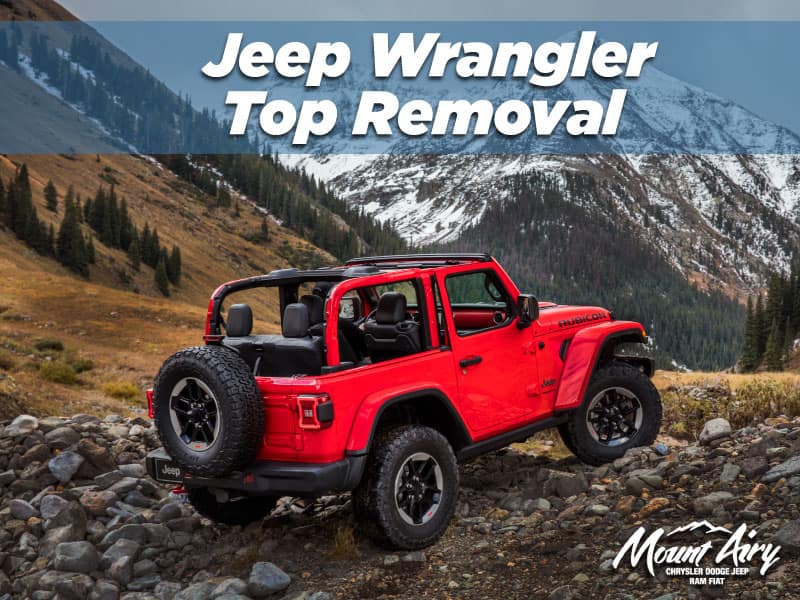
For Jeep Wrangler drivers, new and veteran, Spring is an exciting season. Sure the flowers are blooming and the sun is shining, but what Spring really means is that it’s time to begin deconstructing the Wrangler! Removing the top of your Jeep for the first time this season is sure to be a great feeling and, at Mount Airy Chrysler Dodge Jeep Ram, we have a few important tips for getting it done quickly and correctly. Any seasoned Jeep owner will tell you there is nothing like running a Wrangler down the road with the top off—you sitting, at that elevation with that iconic machine, it makes driving in a convertible feel like opening a window. The next thing that seasoned Wrangler driver will tell you is that there are steps to removing the top, but as you practice, you learn little shortcuts, finding your way of doing things. In the mean time, however, start with the basics, the fundamental steps to both hardtop and soft-top removal on your Jeep Wrangler. Hardtop Removal Removing your hardtop is a two-person job. (You might be able to do it by yourself but, because of its weight, we suggest phoning a friend or calling a neighbor over.) Rather than the top being constructed as one long piece, it is separated into three individual pieces, all of them pretty heavy. Here are the steps we suggest: Remove the eight (two behind the vanity mirrors that pop out and six others that turn inward) latches from inside the cabin, all of which are easy enough to loosen. Take off each of the eight latches and store them either in the trunk of the Jeep or in your garage for safekeeping. Every Wrangler comes standard with a tool kit located in the glove compartment or in the rear of the vehicle. Access and remove this kit, as all tools will be needed to finish removing the hardtop. Behind the driver’s seat, find the windshield wiper fluid line, water hose, and other wires along with them. Next to the wires, line, and hose, there is a red switch. Push the switch to remove the bundle and plug everything into the fitted housing on the same platform. Using the tool kit, remove the six or so screws holding the top down (located on the sides of the Jeep—three on each side). Once removed, place in the designated spot (grommets specially made to hold each screw) in the rear of the Wrangler. Next is the tough part. You and a friend need to lift the top and walk it off the Jeep. We highly recommend having an elevated space ready to hold the top. The less you have to bend over, the better. And remember, lift with your knees, not your back! And there you have it. Hardtop removed. Soft-Top Removal Removing a soft-top is much easier than a hardtop. This is one you can do alone, or with a friend to make it faster. Here are the basic steps: Open the trunk and snap out the plastic tables built into the bottom folds of the rear windshield covering. These truly snap out and should not cause any trouble when removing. Locate the column closest to the trunk. Take each side and pop out, and peel back the Velcro. Detach both rear side windows and place them securely in the trunk. Find the two black latches on the middle of the cabin towards the front. Remove the vanity mirror and pull each latch all the way down. Once both are fully pulled, the soft-top will immediately loosen. Next, lift the soft-top off—this would be easier with the help of someone else, but since the top is pretty light, it’s not as needed as with the hardtop. While you are raising the top with your arms, push up, and backward and the entire top should begin to slowly fall back as the track leads it with your guidance. Once all the way back, find the latch and connect the top down firmly. Lock it in place and you are finished. Remember, it may sound a bit complicated, but as you practice you get better. Mount Airy Chrysler Dodge Jeep Ram is here to help!  There’s something special about tinkering around with your Wrangler, so get that top off and get out on the open road.

2021 Ram 1500: The ONLY Pick for IIHS Top Safety Winner

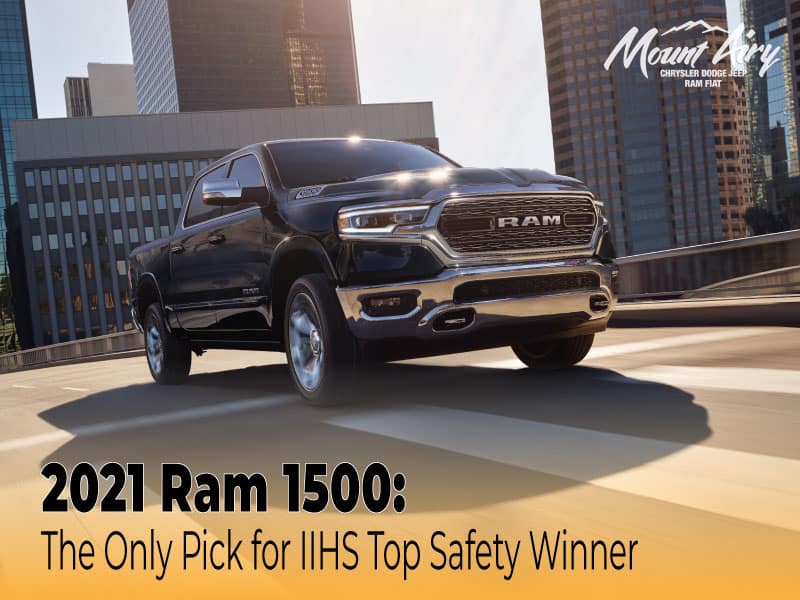
It’s official, the 2021 Ram 1500, equipped with the Advanced Safety Group, has earned the Top Safety Pick rating from the Insurance Institute for Highway Safety. The all-new Ram is the first and only pickup truck to win the prestigious award this year, but this comes as no surprise to truck lovers who have been rambling on about the Ram for decades. This is not the first time the Ram 1500 has won the IIHS Top Safety Pick. It won last year as well, and it was granted the highest possible ratings in all six of the IIHS’s crash tests. Moreover, the IIHS has recognized the Ram 1500’s highly-effective Automatic Emergency Braking (AEB) technology as one of the best in the business. The new Ram truck is as tough as it is safe, and that’s saying a lot. What makes the 2021 Ram 1500 so dang special? Among other things, its 100 available safety and security features are what has piqued the attention of truck enthusiasts and safety regulatory specialists alike. According to Mike Koval Jr., Ram’s Chief Executive Officer, "A Top Safety Pick for the Ram 1500 solidifies our long-standing commitment to our customers through advanced technology and engineering expertise." He also mentions that "This validation from the Insurance Institute for Highway Safety builds consumer confidence in our trucks and the Ram brand." The IIHS evaluates its vehicles rigorously by taking them through six crashworthiness tests, which include three different types of frontal crashes. Other tests are also conducted, which test the consistency of the side panels, rear panels, and there is a rollover test as well. In each and every one of these run-throughs, the 2021 Ram 1500 pickup earned the highest possible scores! 2021 Ram 1500’s Best Safety Features The Ram 1500 has always been noted for its superior safety features, and over the years these features have only become more refined. As we become more advanced, so do our vehicles, which means it’s important that the Ram pickup keep up with the times. For instance, the IIHS has recently required—for those vehicle makers who wish to dawn the moniker of “Top Safety Pick”—Pedestrian Automatic Emergency Braking, which the Ram 1500 has had as an operational safety feature for years. In order for the Ram’s Pedestrian Automatic Emergency Braking system to work properly, and most effectively, the range of the safety system’s radar technology has been expanded so that it can also identify pedestrians. What’s more, the Ram’s radar sensors, in combination with camera technology, will help determine if a collision with another vehicle appears unavoidable, and the system will deploy the brakes to help reduce the severity of the impact. Your Ram truck thinks along with you—and sometimes ahead of you—to keep you safe. Pedestrian Automatic Emergency Braking is part of the Ram 1500's available Advanced Safety Group package, a highly impressive group of systems. This group includes Lane Departure Warning-Plus; Rear Cross Path detection; Blind-spot Monitoring with trailer coverage and Adaptive Cruise Control with Stop; and Go and Hold. Because the Automatic Emergency Braking has become so important, in terms of safety, and since it has earned the highest possible rating in IIHS testing, Ram has made it standard equipment on Laramie, Rebel, Longhorn, Limited Longhorn, and Limited trim levels. AEB is also available in the Tradesman and Bighorn trims that have the Level 1 Equipment Group package. Safety is a forefront idea in the Ram. It seems that everything the truck can do revolves around keeping you, and those with you, safe. Why would you want to drive anything else? Why We Love the All-New Ram 1500 At Mount Airy Chrysler Dodge Jeep Ram, we have always been big fans of Ram trucks because they, for some time now, have been the benchmark for what a truck can be. Ram was the first to offer high-level durability, technology, performance, efficiency, performance, and safety features never before offered in an American pickup. And they continue to do the same today. Just try and not get impressed with these specs: · 1,075 lb.-ft. of torque with Cummins Turbo Diesel · Towing capacity of 37,100 lbs. (in the Ram 3500) · 1,000 lb.-ft of torque with Cummins Turbo Diesel · Payload of 7,680 lbs. (in the Ram 3500) · Most interior space with Ram Mega Cab · Most capable full-size off-road pickup · Most awarded light-duty truck in America · Highest owner loyalty of any half-ton pickup And if that’s not enough to get you excited, here are a couple more specific reasons we love the Ram pickup: · The 2021 Ram 1500 tows up to 2,300 pounds of payload, an impressive amount, and it does so with ease. · The Ram 1500 comes with the eTorque hybrid system that provides much improved fuel efficiency in both Ram configurations: the standard V-6 and the V-8. · Combine the eTorque hybrid system and the 2,300 pounds of payload, and the Ram 1500 is easily the most powerful half-ton pickup—with 480 pounds-feet of torque and 33 miles-per-gallon (that’s up to 1,000 miles of range on one, single tank of fuel!). · There is also the Uconnect 4C that works with a 12-inch touchscreen (which, impressively, includes split-screen capability, SiriusXM with 360L, 360-degree camera shots. · One feature, offered in the 2021 Ram 1500 TRX, we know will quickly become everyone’s favorite is the Know & Go app. This easy app provides clear instructions and explanations on key features of the vehicle. This immersive experience guides the owner through undiscovered features, provides overviews on basic and complicated functionalities, “How-To” videos, and so much more. Active safety and security systems, adaptive cruise control, Forward Collision Warning, Blind-spot Monitoring, Ready Alert Braking—the list goes on and on. The Ram, no matter the trim level, is packed full of high-tech and highly-efficient ingredients, making it our favorite truck. The Ram’s Success A big reason for the success of the Ram truck is its adaptive nature—the Ram is so much more than just a truck, it is a system that makes your driving experience so much more than a trip from one place to another. The 2021 Ram 1500 makes big moves in way of hauling and towing. Its powerful engine can handle heavy-duty loads with ease and a smoothness that you’ll find is just not offered in other comparable trucks—namely, the Chevy Silverado or the Ford F150. Most other trucks are not powered by a revolutionary eTorque, hybrid engine that combines fuel and electricity. And, what keeps the Ram from swaying or vibrating while hauling or towing big loads is its high-strength steel frame. This sturdy skeleton offers up to 12,750 pounds of towing and 2,300 pounds of payload. For those drivers looking to haul on the regular, this is your truck. The 2021 Ram’s rugged luxury lets you get hard work done with style and comfort. So how do you get one of America’s number one selling, top-of-the-line trucks for under for the best price possible? Easy. Come in to Mount Airy Chrysler Dodge Jeep Ram and we’ll have you driving out in the brand-new Ram of your dreams.

Contact Us

Fill out this form below and we'll contact you shortly
*Required Fields