




Mount Airy Chrysler Dodge Jeep Ram FIAT

Blog / Hybrid

Blog

All Hybrid New Inventory Jeep RAM Trucks Dodge Chrysler Service About Mount Airy CDJRF Pre-Owned Inventory Electric Vehicles News Fiat Mount Airy Chrysler Dodge Jeep Ram FIAT Service Mount Airy Chrysler Dealer Used Cars Safety Trade In Community Events Finance Jeep Compass Jeep Wagoneer Jeep Wrangler New Technology Accessories Jeep Gladiator Jeep Grand Cherokee People Christmas Year End Sales Minivans Mount Airy Used Cars Black Friday Commercial Trucks & Vans Jeep Trim Levels Mount Airy Chrysler Service
2021 Jeep Wrangler in Mount Airy, NC

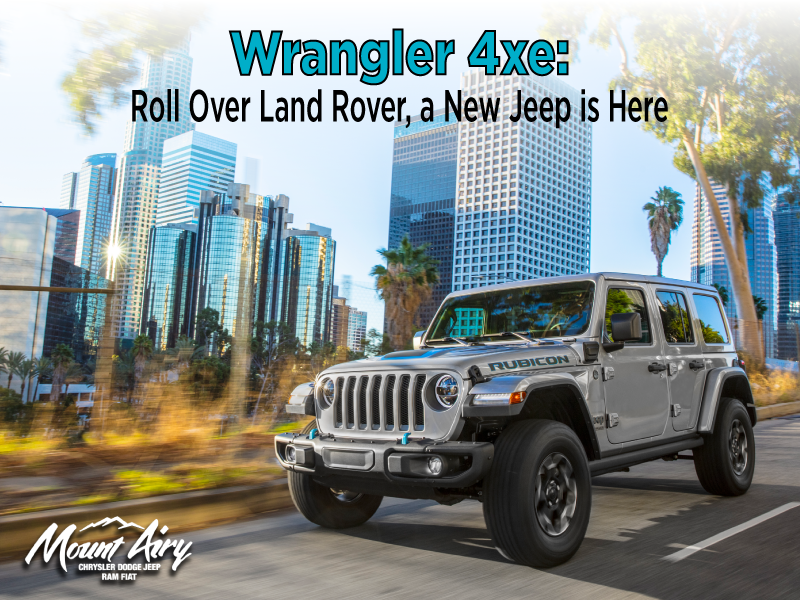
Wrangler 4xe: Roll Over Land Rover, a New Jeep is Here

“Plug Into More Adventure” is the motto around Jeep these days. The arrival of the much-anticipated Wrangler 4xe comes boldly, addressing key issues head-on with plug-in vehicles—especially those vehicles with the brute force and physique of the Wrangler—such as range anxiety, longevity, and overall power. The Wrangler 4xe is a powerhouse of an SUV, and the most electric Wrangler we’ve ever seen. Jeep has just made history with the all-new Wrangler 4xe Hybrid. The arrival of a new Wrangler is always exciting. Over the decades the Jeep Wrangler has grown up with us, it has become a part of our lives. With that iconic front grille and headlights, the boxy frame, the endless capabilities, the Wrangler is as American as apple pie, and though the times they are changing, Jeep Wrangler is changing right along with them. With a new electric-hybrid Wrangler, Jeep is putting a bold foot forward and setting a standard for plug-in SUVs. The all-new Wrangler 4xe is everything you want in a Wrangler and so much more. Capability The Wrangler 4xe is more than capable. With 470 pound-feet of torque, the 4xe can climb over tough terrain and hit 0-60 miles per hour within 6 seconds. So, it’s tough and fast? No—it’s way more than that. First and foremost, the new Wrangler identifies as a 4x4. After all, how could a venerable machine such as the Jeep Wrangler deny its roots: traipsing through rock and dirt, pulling and pushing through mud and sand. But over the last decade or so, the Wrangler has become more comfortable, more family-friendly, but without losing its edge and power. Now add some electric sporty speed and the new Wrangler becomes a triple threat. The Wrangler 4xe provides 375 horsepower and comes with a 2.0-liter, I4 DOHC direct-injection Turbo PHEV engine that allows for the very best power and capability. There’s also a 16-kWh lithium-ion battery pack, a regenerative brake booster, and an 8-speed automatic transmission constantly providing power and charge to each wheel of the Wrangler. And what’s really great about all this is that the battery pack and electronics are sealed and waterproofed so you can drive in up to 30 inches of water without any interference. Range Anxiety Here’s a quick way to quell that range anxiety: the Wrangler 4xe gets 49 mpg, and it has a 370-mile range! Since there are different modes the Wrangler 4xe can operate under (more on this in a minute), you are able to maintain control no matter the driving conditions. The E-Save driving mode, in particular, allows you to drive for long distances due to the fact it only uses battery power for low-emissions zones like cities or light off-roading. This saves battery power for later and gives you, the driver, the best of both worlds—a powerful, fun drive that saves power and enables you to drive farther. Here are more driving modes and cool features to the Wrangler 4xe: Hybrid Mode. This is the 4xe’s default mode, as it combines the turbocharged engine’s torque with the electric motors to provide plenty of horsepower and instant torque, but by using the electric power first. This mode saves on fuel but doesn’t lack any power. Electric Mode. To run fully electric, the Wrangler only requires a 1% charge. Under the Electric Mode, and with a full charge, the 4xe can go for 21 miles, producing almost no tailpipe emissions even at highway speeds. Regenerative Braking. This impressive feature actually charges your battery while you decelerate and brake. The Max Regeneration technology accesses the accelerator pedal and commands more aggressive regen at low pedal positions. What exactly does that mean? It means that the vehicle can slow down without pressing the brake pedal, and while the Wrangler is decelerating, the battery is building power for later use. This feature stays on until you turn it off. Rechargeable Feature. It only takes 2 hours to fully recharge the Wrangler 4xe’s battery when using a Level II charger (240-volt), while it takes 12 hours using the Level I charger (120-volt that comes included with your new 4xe). We strongly suggest purchasing a Level II ($500-$700), especially if you plan to utilize the electric feature of the SUV a lot—and why wouldn’t you? Incentives for Buying the Wrangler 4xe Did you know that when you get any new Jeep vehicle you are automatically enrolled into what’s called the “Jeep Wave” program? This is a maintenance-free, thirty-day period for every Jeep purchase or lease on 2021 models. It comes with free maintenance and dedicated support anytime (24/7), plus much more—it’s actually cited on the Jeep website as being “the most valuable customer care program in America.” But there’s more. There are also state incentives to buying electric or hybrid vehicles. For instance, in North Carolina when you buy a hybrid Wrangler 4xe, you can get a tax credit, called “The Plug-in Electric Drive Vehicle Credit,” that offers up to $7,500. There is also what’s called the “High Occupancy Vehicle Transportation Privilege,” which is a state benefit where qualified plug-in electric vehicles, such as the Jeep Wrangler 4xe, are able to operate in the high-occupancy vehicle lanes, but regardless of the number of occupants. Check out the Jeep website to find out more about state incentives for buying or leasing the all-new Wrangler 4xe. Wrangler 4xe Versus Land Rover There is, and has been, a strong debate about who makes a better 4x4—Wrangler or Rover? And with the emergence of a hybrid Wrangler, we thought it would be a good idea to revisit this famous rivalry to see which is the better SUV. Beginning with price, the Wrangler 4xe and the Rover Defender Hybrid both come at around $47,000. This is steep, but you have to keep in mind the state incentives you will be getting, as well as, all the cash you will save at the pump. Looking at the standard Wrangler against the standard Land Rover, there are a lot of important aspects to consider: Wrangler has more headroom and front legroom The Wrangler has more clearance than the Rover Wrangler has thicker brakes and lighter rear wheels Both vehicles have similar transmission capabilities So far, the Wrangler has gone through more rigorous crash testing (and has produced strong results) than the standard Land Rover. The biggest differences come by way of physique and interior comfort and design. The Wrangler is a bit more bare-boned than the Rover, but that simplicity is one of the aspects that has made the Wrangler popular. That said, there is plenty of new and impressive technology inside the new Wranglers—hybrid or otherwise—not to mention the plush upgrades you can make with seating and the dexterity of the machine as a whole. But when it comes to driving, both vehicles are pretty similar; that is if you are on the pavement. Off-roading, we like the Wrangler much better. Its open-air design places passengers in nature with removable doors and windows. The Rover just doesn’t have the capability to transform as the Wranglers do, and that makes a huge difference. Then there’s the raw power of the Wrangler 4xe that is so impressive, each mode providing its own unique area of power and precision, 0-60 in 6 seconds, the list goes on. Here is a specific comparison of key features to a Standard Wrangler, the Wrangler 4xe hybrid, and the Land Rover Defender, just to get a good look at how well the 4xe stands out: Engine Wrangler Wrangler 4xe Rover Defender 3.6-liter V-6                2.0-liter Turbo inline-4 plug-in           2.0-liter Turbo inline-4 Transmission Wrangler Wrangler 4xe Rover Defender 6-speed manual           8-speed automatic                               8-speed automatic 8-speed auto Drivetrain Wrangler Wrangler 4xe Rover Defender 4-wheel drive              4-wheel drive                                      4-wheel drive Fuel Tank Capacity Wrangler Wrangler 4xe Rover Defender 17.5 gallons                 17.2 gallons                                         23.4 gallons Fuel Economy Wrangler Wrangler 4xe Rover Defender 17mpg-city                  49mpg-combined                                18mpg-city 25mpg-hwy                 370-mile distance                               21mpg-hwy Seating Capacity Wrangler Wrangler 4xe Rover Defender 4 seater                        5 seater                                                5 seater At Mount Airy Chrysler Dodge, Jeep, Ram we are very excited about the all-new Jeep Wrangler 4xe. A plug-in Wrangler is finally here and it’s more powerful and impressive than we could have imagined. Stop over and test drive one for yourself!

Jeep Wrangler Hybrid

Jeep Wrangler Joins the Growing List of Hybrid Vehicles

If you’re a fan of hybrid vehicles but have been waiting for one with more power and rugged outdoor appeal to appear, than your time may have finally arrived. Fiat Chrysler Automobiles (FCA), makers of well-known car brands such as Chrysler, Dodge, Jeep, Fiat, and Ram, has confirmed plans to expand their line of electric hybrid vehicles to include the Jeep Wrangler. FCA currently has one hybrid model, The Chrysler Pacifica, which offers a plug-in version for purchase. However, they have a lofty goal of offering as many as 30 electric hybrid models by the year 2022. As with other electric hybrid vehicles, the Jeep Wrangler will have an electric plug that is used for charging. Advantages to the hybrid model include a higher fuel economy and increased engine power. Current fuel economy is 18/23 miles per gallon. With the new Jeep hybrid model that economy increases to 23/25 miles per gallon. And while there is still speculation as to what type of engine will be used, many believe that some form of the Chrysler Pacifica minivan’s 260 horsepower V6 engine will show up under the chasse, as the Jeep currently uses a similar type of engine. So how exactly does a hybrid engine work to influence overall miles per gallon? As you may have already guessed, it works through the use of electricity. Where a traditional engine would have an alternator, the new hybrid Jeep Wrangler houses a powerful 22-horsepower electric engine in addition to the traditional one. This electric engine uses a 48-volt battery for all starts and stops of the vehicle. Housing an electric engine for this purpose allows the vehicle to conserve gasoline and raises the overall miles per gallon. The electric battery also has regenerative features so that every time you brake or coast, you’re helping to charge the battery. So ideally, you’re refueling the battery and saving gasoline all in one action. And while the exact number of miles the battery can run without assistance from the traditional engine hasn’t yet been announced, it’s expected to fall somewhere around the mileage currently being achieved by the Chrysler Pacifica hybrid, which comes in at an impressive 32 miles.  Not too shabby for a rugged, off-road vehicle like the Jeep Wrangler. As you might expect, the overall cost is a bit extra for this upgraded feature. You can plan to pay about $3000 more for the hybrid engine and the required eight-speed automatic transmission that accompanies it. However, if you pair that cost with your overall gas savings and were planning on buying an automatic versus manual transmission regardless, you can expect to recoup your initial investment after around four years of ownership (This number assumes an average of 55% city driving). Jeeps are made to be freewheeling, off-roading, hard-working vehicles so, of course, the biggest question that people tend to ask is, “Will I need to sacrifice ruggedness and power in exchange for a hybrid engine?” And the answer looks to be an emphatic NO. Everything you see on the jeep from the bumpers to the axles is still designed with an off-road adventure-driven owner in mind. The jeep still comes with the soft and hardtop and, as always, drivers still have the option to take the doors off or leave them on. Jeeps are also still crash-tested at the same standards as other cars to assure overall safety regardless of the conditions you’re driving it in. You can also still count on the same firm ride as the non-hybrid and that an acceptable level of interior noise will be heard. Finally, as an added bonus, the new hybrid Jeep Wrangler can accelerate from 0 to 60 miles per hour in a mere 7 seconds. Not too shabby for a hybrid! If you’re in the market for a rugged off-road vehicle, we highly recommend you research and test drive the new 2020 Jeep Wrangler. With everything from reliable off-road capability to overall improved driving performance and gas mileage, now is the time to make the switch to hybrid. And when it comes to finding the right dealership for the job, Mount Airy Chrysler, Dodge, Jeep, Ram, and Fiat has you covered. Stop by to talk with one of our professionals and take a test drive today. We look forward to serving you!     Julie Mastbrook Works Cited “2020 Jeep JL Wrangler PHEV Plug-In Hybrid First Sighting!” 2018+ Jeep Wrangler (JL) News and Forum - JLwranglerforums.com, 2018+ Jeep Wrangler (JL) News and Forum - JLwranglerforums.com, 20 Mar. 2019, www.jlwranglerforums.com/2020-jeep-jl-wrangler-phev-plug-in-hybrid-first-sighting/. Cantu, michael. “Jeep Wrangler Plug-in Hybrid on Track for 2020 Launch.” MotorTrend, 17 Aug. 2018, www.motortrend.com/news/jeep-wrangler-plug-in-hybrid-on-track-for-2020-launch/. Capparella, Joey. “2020 Jeep Wrangler Expands Engine Options with a New V-6 ETorque Hybrid.” Car and Driver, Car and Driver, 15 July 2019, www.caranddriver.com/news/a28396620/2020-jeep-wrangler-new-v-6-hybrid-engine/. Stocksdale, Joel. “2021 Jeep Wrangler Plug-in Hybrid Caught Undisguised.” Autoblog, 20 Mar. 2019, www.autoblog.com/2019/03/20/2021-jeep-wrangler-phev-spy-photos/. Wiese, Dan. “Jeep Wrangler Hybrid: Hybrid Is One More Step in Roughneck's Search for Acceptance in Polite Society.” Stltoday.com, 26 Feb. 2019, www.stltoday.com/brandavestudios/jeep-wrangler-hybrid-hybrid-is-one-more-step-in-roughneck/article_4b45882a-39e3-11e9-a535-ef9f47897c9d.html.

Electric Vehicles

How BEVs Could Be the Future (And Why They May Not Be)

Demand for plug-in electric vehicles (EVs) is growing, though they still only claimed about 2% of the U.S. market share in 2018 (global market share is similar). That number includes battery-operated vehicles (BEVs) and plug-in hybrid electric vehicles (PHEVs). The thought on everyone's mind: is this the future of driving? The primary difference between the two types of vehicles is that a BEV runs solely off the energy from the vehicle's battery, while a PHEV uses the battery alongside a fuel tank that kicks in at various intervals. There would be clear benefits to drivers and the environment if BEVs were to become mainstream. However, there are currently just too many drawbacks to know how successful the BEV market can become. While many proponents are hopeful that BEVs will eventually become commonplace, the future of these vehicles remains largely unknown due to a number of unanswered questions and issues yet to be resolved. For instance, how will drivers have access to charging their vehicles? Will there be convenient charging stations like there are gas stations? Also, can we expect improvements to be made with batteries in the future? This article will explore the potential advantages of a BEV-driven world and the challenges that BEV drivers currently face, and we'll take a look at some of the main questions and issues that are too prevalent to be ignored. ADVANTAGES OF A BEV-HEAVY MARKET Even though we are still in the early stages of developing electric vehicles, BEVs currently come with many benefits, and it's not hard to see how these benefits could become even more impactful as technology improves. Lower Operating Costs For one, it's much cheaper to charge a BEV than it is to run a traditional vehicle off of gas; it's actually about one-third of the cost. Also, a BEV contains very few moving parts compared to a traditional vehicle, which means it's less expensive to maintain. For instance, with a BEV you don't have to worry about servicing a starter motor, fuel injection system, exhaust system, or radiator, among many other components. Though many improvements need to be made to these vehicles' batteries, most BEV manufacturers provide an eight-year warranty on their batteries even now. Environmental Benefits Some of the most obvious advantages are those that benefit the environment. BEVs have virtually no exhaust emissions, which means they emit much less pollution than traditional vehicles do. And if you use renewable energy for charging, greenhouse gas emissions are reduced even lower. For example, rather than charging from the grid, you can use a polar PV system while there's daylight. If you must use the grid, you can still minimize greenhouse gas emissions by purchasing green power from your electricity company. Even the manufacturing of some of the top BEVs is eco-conscious. For instance, the Ford Focus Electric and Nissan Leaf are largely made of recycled and bio-based materials, such as plastic bags, water bottles, and second-hand car parts and home appliances. Health and Safety Along with the financial and environmental benefits, BEVs can help improve our health and safety. Less pollution from exhaust means better air quality, which can reduce health problems caused by pollution, and BEVs create much less noise pollution than traditional vehicles. Also, since BEVs typically have a lower center of gravity, they are less likely to roll over. Furthermore, fires aren't as much of a risk, and the body structure of BEVs can prove more durable in a collision. DISADVANTAGES OF CURRENT BEV MARKET Of course, there are also drawbacks to BEVs. While they have enjoyed success, it has been with a limited group of consumers. Charging Times Tesla has led innovation in the BEV market in many ways, including its Supercharger networks, which can charge vehicles in about 30 minutes. However, that's still a lot more time than it takes to fill the gas tank of a traditional vehicle. What's more, scientists behind the efforts of manufacturers like Tesla and Toyota have their doubts about the possibility of reducing charging times enough to satisfy mainstream consumers. And since Toyota has been in the electric vehicle game for over 20 years, that speaks to the magnitude of this problem. Electricity Generated Another prevalent issue with BEVs is that they require electricity, which must come from somewhere. In states like California, most of the electricity comes from natural gas supplies, but states like West Virginia use coal to generate up to 90% of its electricity. Overall, about 38% of electricity in the United States is generated by coal. This begs the question: just how clean and green are electric cars? In short, it depends on where in the country you are driving. Furthermore, the lithium-ion batteries used by manufacturers like Tesla contain components that can potentially harm the environment by way of ecological toxicity and contributing to global warming. Limited Categories Finally, you don't see any BEVs that fall under the heavy-duty truck category. This is mainly because the technology isn't workable for truck applications—and it won't be anytime soon. This is a serious problem because there are 2 to 3 million heavy-duty trucks on the road in the U.S. Much of the American economy depends on Class 8 commercial trucks, which guzzle 30 times more gas than the average automobile (about 35 billion gallons each year). It's difficult to see how BEV technology could advance enough to accommodate the heavy-duty truck category in the foreseeable future. However, if such trucks were able to be produced in an electric format, it could drastically decrease oil dependence and significantly benefit the trucking industry financially. THE IMPORTANCE OF CHARGING STATIONS There are currently about 20,000 public charging stations and 57,000 outlets for plug-in electric vehicles in the U.S. Here's the thing: 4,800 of those stations and 18,200 of those outlets are found in California. Not surprisingly, California has also accounted for almost half of all BEV sales in the country since 2011. If there is hope for the BEV market to experience continued growth—and especially if battery-operated cars are to become mainstream—there must be more charging stations created throughout the country. In a sense, the future popularity of BEVs in any particular area of the country depends on the accessibility of charging stations in that area. However, it gets tricky because states that don't sell a lot of BEVs are less inclined to invest in public charging stations, but if they never decide to invest, then their sales will probably not improve by much. Therefore, there must be a break in the cycle at some point if BEVs are to become commonplace in the future. Sure, there are some people who could charge their BEV at home, but that's a limited category of consumers. Without an adequate number of charging stations open to the public, much like gas stations are, BEVs will never reach the mainstream. To put it into perspective, there are approximately 168,000 public gas stations in the U.S.—more than eight times the number of charging stations. The majority of consumers will never make the jump to BEVs until that gap is dramatically closing. THE ROLE OF BATTERIES As essential as charging stations are for the future of BEVs, batteries may play an even more important role. And BEV batteries need to undergo a lot of development if electric vehicles are to become commonplace. Battery Anxiety The term "battery anxiety" is often used in reference to one running out of battery power on their smartphone. We've all seen the symptoms: a family member searching frantically for a charger cable; a co-worker turning their desk over, only to ask you if they can borrow a charger; even a stranger asking if they can PowerShare with your phone. Chances are you've experienced the symptoms yourself. In a study administered by electronics manufacturer LG, 9 out of 10 people showed signs of battery anxiety. The same logic is behind the term "range anxiety" in reference to electric vehicles. If such a phenomenon has that kind of grip on people with smartphones, you can imagine the impact of this anxiety when it comes to driving a car. Range anxiety is one reason why many consumers won't even consider going the BEV route. Most BEVs allow drivers to go about 100 miles fully charged (the Tesla Model S is an exception, as it allows drivers around 250 miles). This is another reason why the scarcity of charging stations is such a severe problem. Nonetheless, many manufacturers have pledged to develop BEVs that will hit about 200 miles per charge. That would surely make a big difference, but it's still a far cry from a conventional vehicle that can go 300 to 400 miles on a full tank of gas. The Problem with Lithium-Ion Batteries Most newer electric cars these days are powered by lithium-ion batteries. These batteries are not without their advantages, such as the fact that they are light-weight (as compared to lead-acid batteries), relatively low-maintenance and can last for 8-10 years. However, there are some serious issues to consider as well. For example, lithium-ion batteries are expensive. While a high-end lead-acid battery—as used in most traditional vehicles—costs around $120, a typical lithium-ion car battery costs in the $1,700 range. Also, lithium is highly reactive. This means if they are damaged or installed incorrectly, they can explode. Moreover, the cells used in lithium-ion batteries are made with rare-earth metals; the supply of these metals is limited, and they're dangerous to mine. Most workers who are tasked with retrieving rare-earth metals are laboring in harsh conditions, to say the least (and in some cases this means illegal child laborers). The Prospect of Flow Batteries Enter a new hope for BEV proponents: the "flow battery." Scientists are currently working on this new type of refillable battery that they hope will replace lithium-ion as the commonplace battery in BEVs. The strongest appeal of the flow battery is that it solves most of the biggest problems consumers have with BEVs. Depending on the model of vehicle and the power source used, it can take anywhere from 30 minutes to 10 hours to fully charge a lithium-ion battery in a BEV. If the flow battery is a success, it will allow drivers to empty their battery liquid and pump in new liquid in minutes—roughly the same time it would take to fill a gas tank. What's more, since the basic infrastructure is already there, it would be easier for gas stations everywhere to be retrofitted to pump this battery liquid in place of gas. This means that the scarcity of charging stations would no longer be a problem—thus, no more range anxiety. There is still a lot of progress to be made in the development of flow batteries, but it's possible we will see some form of them in the next three years. THE BOTTOM LINE It's easy to see how drivers and the environment would benefit from a BEV-driven market. All things considered, they are a more eco-conscious alternative to traditional vehicles, they are cheaper to operate, and they offer health and safety benefits. That said, BEVs have their share of drawbacks as well. If BEVs are ever to enter the mainstream, more charging stations and better batteries must be made available. It looks like the work is being done to solve these issues, but only time will tell whether or not BEVs are indeed the future.     -Alex Watson

America’s First and Only Hybrid Minivan

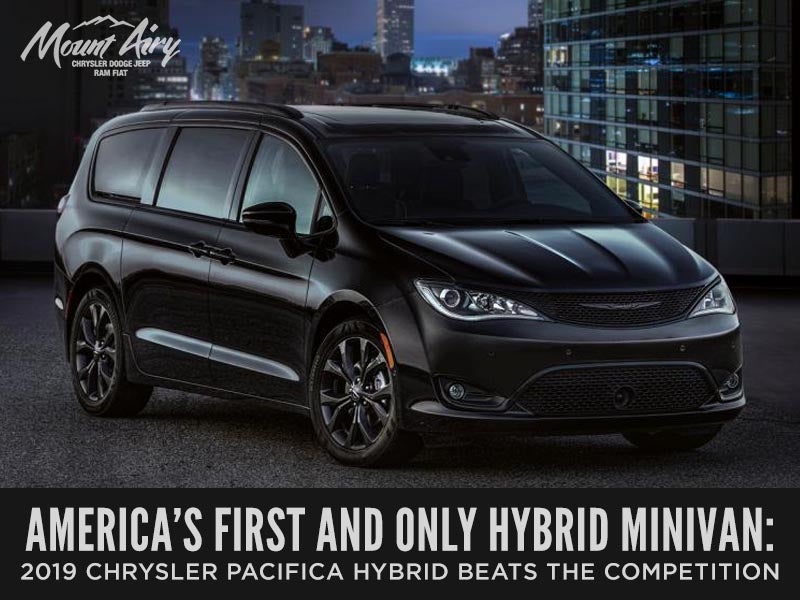
America’s First and Only Hybrid Minivan: 2019 Chrysler Pacifica Hybrid Beats Out the Competition

America’s families have asked and Chrysler has delivered. Introducing America’s first hybrid minivan, and the largest hybrid vehicle in the U.S., the 2019 Chrysler Pacifica Hybrid is the best of its class. The 2019 Pacifica Hybrid, according to Business Insider, still outranks Honda and Toyota’s comparable models. Now at Mount Airy Chrysler Dodge Jeep Ram Fiat, you can take the 2019 Pacifica Hybrid for a spin and fall in love with a vehicle that delivers the greatest fuel efficiency, electric mileage, and style for your money today. At a glance: America’s largest hybrid vehicle The most technologically advanced seven-passenger hybrid MSRP: From $40,245 $7500 tax credit 3 rows of family-friendly seating The best combination of safety and fun for your next road trip Hybrids: A More than Happy Medium Hybrid vehicles are a great gateway to the world of plug-ins and electric vehicles. For an everyday vehicle to run errands, commutes, and kids all around, a hybrid means you lose very little by gaining a plug and enough electric range for many people to never use a drop of gas. The Pacifica Hybrid is specifically a great vehicle for families who can’t make the leap to a fully electric vehicle. Hybrids are reasonable; with a lack of infrastructure in place, such as the absence of charging stations for electric vehicles right now in North Carolina, electric vehicles just aren’t cut out for out-of-town family visits or longer road trips. But for those who want to keep their driving local or cut down emissions, or go entirely tailpipe-emissions free, the Pacifica Hybrid is the way to go. Saving You Money, and Saving You Time Charging an electric vehicle isn’t as fast as pumping gasoline for sure, but it does not have to have to take up all of your time. You can charge your battery at home in only two hours with the available 240-volt Level II charger. In comparison… The Pacifica Hybrid 2019’s quick charge in just two hours is faster than the Mitsubishi Outlander PHEV, the Volvo XC90 Plug-In Hybrid, and the Chevrolet Volt. We’d say that’s pretty quick! Chrysler Pacifica Hybrid: 2 hours Chevrolet Volt: 2.3 hours Volvo XC90 Plug-In Hybrid: 3.0 hours Mitsubishi Outlander PHEV: 3.5 hours Safe. Secure. Sound. The Chrysler Pacifica Hybrid has over 100 standard and available safety and security features. Some of these impressive features include: Available full-speed forward collision with active braking Available LaneSense lane departure warning with lane keep assist Available adaptive cruise control with stop and go Available 360 degree surround-view camera Fog Front driving lights ParkSense with Stop Parking assist And what’s the overall NHTSA safety rating? It shouldn’t be surprising that the Pacifica Hybrid received a 5/5 rating. What is the total combined driving range of the Pacifica Hybrid? The Pacifica Hybrid has an 82 MPG rating, and a 32-mile electric range with an incredible total driving range of up to 520 miles. All of those family vacations you have been dreaming of? Totally within your reach. Crunching Numbers and Configurations: The Chrysler Pacifica Hybrid at a glance includes: Payload: 1,313 lbs Warranty: 3 yr/36,000 miles basic, or a 5 yr/60,000 miles powertrain Curb weight: 4,987 lbs Fuel tank capacity: 16.5 gallons Engine: 3.6L V-6 Transmission: 1-speed automatic Power: @ rpm Drivetrain: front-wheel The configurations range from: Touring Plus: $40,245 Touring L: $42,445 Limited: $45,795 Specs: Riding in Style and Comfort The interior of the Chrysler Pacifica Hybrid is designed to impress. With the most innovative seating and storage in its class and an eco-chic design, the Chrysler Pacifica Hybrid is as family friendly as it is environmentally friendly. The basic trim includes ABS and driveline traction control, with 17-inch polished and painted accented aluminum wheels. Climate control in the vehicle truly gives control to everyone in the vehicle. The Pacifica includes front air conditioning, dual-zone automatic, and rear air conditioning as well. It may be cold in the driver’s seat but are the kids complaining about being hot in the back? Separate controls in the back ensure everyone in the vehicle is comfortable. For radio-aficionados, the Pacifica comes standard with SiriusXM, AM/FM/HD/Satellite, and a seek-scan radio, all controlled by two first row LCD monitors. These monitors feature the most advanced entertainment system available in seven-passenger hybrid, meaning fun, immersive, and smart interaction for the whole family. All of the doors on the Pacifica include Keyfob Remote keyless entry. It also includes heated mirrors, cloth seat trim, driver lumbar support, and a 60-40 split-bench third-row seats. The Touring Plus trim provides the driver and front passenger heated-cushion, heated-seatback, heated front seats, and a leather seat trim. The additional or replacing feature on Touring L trim includes Nappa leather seat trim, driver and passenger lumbar support, a navigation system, a panoramic sunroof, 20 speaker Harman Kardon sound, a $775 S Appearance package, and a 120 AC outlet. What does the Pacifica Hybrid cost? The price ranges from $41,490 to $51,050 depending on the trim levels. Does the Pacifica Hybrid qualify for a tax credit? When you purchase an electric vehicle, you may be eligible for a one-time federal tax credit of up to $7500, which is not an incentive guaranteed for other hybrid vehicles on the market. It’s worth noting that this nonrefundable credit doesn’t carry over year to year, so make sure you take advantage of this tax credit while you can. You can receive a portion of the $7500 tax credit even if your tax liability is below $7500. Ask our team at Mount Airy CDJRF if you’re interested in learning more about the tax incentives available to you. The Pacifica Hybrid: How does it work on a long haul? What if you can’t plug in to charge? While the Pacifica doesn’t have enough battery capacity to go entirely on electric power, it can be used as fully electric around town, and as a hybrid for long trips. With a quiet ride inside, excellent captain’s chairs in the first and second rows, and room for seven total passengers, there’s nothing keeping you from enjoying a road trip in this vehicle. The Pacifica Hybrid delivers more usable all-electric range than most other plug-in hybrids and actually recharges the battery pack on regenerative brakes. So, even if you’re running on gas, as you drive and stop, the battery can recharge slightly. Now you can drive where you want when you want without any of the range anxiety. The Chrysler Pacifica Hybrid seamlessly switches from an electric motor to a gas engine for greater peace of mind and total hybrid power. How do you charge it and how long does it take? When you purchase a Pacifica Hybrid, it comes equipped with a Level I 120-volt AC charging cord set, which requires a conventional 120-volt AC grounded wall receptacle along with the portable charging cord set.  Ensure that your vehicle is turned off and plug the charger cord into the vehicle's power outlet. You can find the charging cord set by opening the cargo area storage bin on the driver’s side, which includes the charging cord in a storage bag. Keep in mind that this cord set is for Level I charging only. Once you begin, insert the AC plug of the charging set into the grounded wall receptacle. Then take the charge connector and place it in the vehicle’s charge inlet. A “click” will be heard when inserted correctly, and the charge active indicator lights will cycle from left to right. Once your vehicle is fully charged, the lights in the charge indicator will show all five bars. You can also set a charging schedule with the available 4C NAV in the Hybrid Electric pages app. On the Charging Schedule page, you can set a charging schedule by checking the box next to the setting “Enable Schedule” and customizing as needed. You can choose to “charge Until Full,” which allows the vehicle to fully charge versus stopping at a certain point. You can manage all of this right from your smartphone. The Level 1 120-volt charger can be fully recharged in approximately 14 hours. You can shorten the time and charge your Chrysler Pacifica Hybrid in as little as 2 hours by using an available Level II 240-volt charger. Charging times are estimated but can change based on the age and condition of the battery, and the current provided to the charger. What’s the expected life of the battery? The expected life of the lithium-ion battery is the life of the vehicle. What about charging from a public charging station? How long does that take? At a public charging station, the Pacifica Hybrid can be charged on Level II 240-volt chargers and takes around 2 hours to fully charge from a completely empty battery. What is the estimated cost of charging the Chrysler Pacifica Hybrid? It takes 13k to fully charge the battery and using the national average electricity rate of $0.12/kWh, it costs approximately $1.66 to fully charge the battery using a home charger. Can you tow with a Chrysler Pacifica Hybrid? If so, how much can it tow? Towing a trailer is not permitted on the 2019 Pacifica Hybrid, as hybrids are not rated for towing and the added weight of the battery already weighs on the vehicle significantly. You cannot order the Pacifica Hybrid with a towing package as a result. The non-hybrid Pacifica with the tow package is rated for 3.6K lbs. Is the Pacifica Hybrid worth it? Here at Mount Airy CDJRF, we believe that the Pacifica Hybrid 2019 speaks for itself. As not just the only hybrid minivan on the market, but the best of the best when it comes to your hybrid family vehicle options, the Chrysler Pacifica is a classic in the making and built to suit families of all kinds. Torn between the Pacifica and the Pacifica Hybrid? It’s hard to justify not buying the plug-ins, as the non-hybrid is basically the same as the hybrid unless you really need the second-row seat to fold into the floor on a regular basis, or if you’re locked into a tighter budget and are seeking a lower spec Pacifica. With seating for up to seven, it’s the perfect vehicle for families big and small. With the purchase of a Chrysler Pacifica Hybrid, you may be able to factor in the $7500 federal EV tax credit, alongside other possible state and local added incentives, meaning that the hybrid can definitely cost less than the equivalent non-hybrid Pacifica, or other similar vehicles. For example, any other minivan, including the Honda Odyssey, gets nearly as expensive when matching what the Pacifica includes, and they don’t qualify for the $7500 EV tax credit, or other incentives like the carpool lane stickers. Come by Mount Airy CDJRF today to check out the 2019 Chrysler Pacifica Hybrid and see why it’s truly the best in its class.   -Tayler Green

Contact Us

Fill out this form below and we'll contact you shortly
*Required Fields